
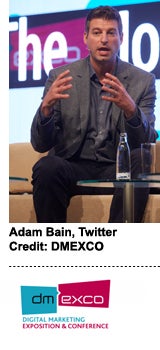
 Jack Dorsey will apparently not be the next full-time CEO at Twitter, bringing Adam Bain, the company’s top sales exec and a presumptive candidate for the job, a step closer to the throne.
Dorsey has been whispering to Square investors that he will stay on as CEO of the payments company, Re/code reported Thursday. But that doesn’t mean Bain – the other frequently mentioned CEO candidate – will automatically succeed Dick Costolo, gone three months.
In an interview onstage at the DMEXCO conference in Germany, Bain dodged a question on Twitter’s CEO search before diving into some facets of Twitter’s user growth and advertising businesses.
What appears below are salient points from the discussion, which was facilitated by entrepreneur John Battelle. It has been edited for clarity and flow:
On the user retention challenge: After Twitter went public, the analyst question du jour became, “How will you scale and retain monthly active users?” Was this a hard engineering problem for Twitter? Absolutely, but this [Twitter’s Project Lightning] isn’t one gestation. It’s the result of a series of launches for us. [Headlines] that talk about 300 million logged-in users don’t account for logged-out users. We have over a billion users in syndication [who see embedded tweets on other sites and apps].
On monetizing beyond the tweetstream: In terms of our rhythm of execution, we have pace and clarity. We just had a big commerce announcement to open up the buy button to bring retailer SKUs onto the platform where any retailer can publish products to Twitter through a set of open APIs. It’s super early days for commerce. … We also have our off-Twitter revenue stream and licensing business through MoPub. The No. 1 thing we’ve been thinking about is how to make our platform easier for marketers. The acquisition of MoPub helped us get scale in content syndication and ads.

We abandoned what many people were used to with display advertising and brought something native and useful to the platform – tweets inspired by things like search and TV. We have a great working relationship with television through Twitter Amplify where we’re bringing premium content from those providers. We have a multidimensional partnership with Google, [first with] tweets displaying in search in the US, which will scale to other nations.
On video: We acquired a company called Niche, which is a bunch of content producers who quit their day jobs and produce content for marketers. If marketers who come to us are looking for creativity, we can connect them with a Niche creator to connect them with Viners and Periscopers. With Vine, Periscope, Niche and Twitter Amplify, we’ve created a world where video plays natively inside the tweet. We see 1.2 billion video loops on Vine every day and, during the first week of August, we passed 10 million users on Periscope.
On content relevancy: One of the problems with having a lot of content is finding the things you care about. If you tune Twitter [to your interests] you get a great content delivery experience. But oftentimes you miss what’s going on in the world. Project Lightning aims to bundle content for consumers around news they don’t follow in their main timeline. It’s content curation through a mix of human and algorithmic solutions.
When you think about organization and discovery, Project Lightning solves challenges around brand-new users and our most active, hardcore users. We know there’s a learning curve and that it takes energy to scale on our platform, especially for our logged-out audience.