

 After going digital-only in June 2013, The Onion had to decide how to earn money without print ad sales. It found a partial answer in Onion Labs, its in-house agency that has found success with big advertisers.
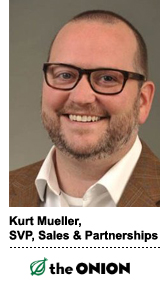
“We thought, are we going to go down the programmatic path or the content path?” said Kurt Mueller, SVP of sales and partnerships for The Onion. “It was obvious to us where we would be able to differentiate: The Onion creates great content. Given that content is such a strength for us, we decided to go down this road.”
The Onion’s branded content is now distributed beyond just its own website and its sister site, Clickhole. Brands can create videos to put on their own sites or social channels, as YouTube does with its annual Onion-created April Fool’s Day video.
Mueller talked with AdExchanger.
AdExchanger: What’s your approach to native advertising? How has that evolved over time?
KURT MUELLER: We take the greatest comedy writers in the world and combine that with traditional, savvy marketers, and work together to create content for brands. It might be social execution or branded entertainment. It could be content that the brand will distribute itself or be distributed on our site.
I would say that more than 90% of what we do has some content element to it.

How much is on your site vs. distributed by the brand?
It depends on what the brand is setting out to do. Do they want us to be the behind-the-curtain partner and take credit for it, or do they want to get that affinity and context from being on our site? When we do YouTube’s April Fool’s joke, they don’t need us to distribute that.
What kind of amplification do you do of branded content?
Brands do that, generally. We have such a sizeable audience we don’t spend a lot of time amplifying content. We definitely leverage our social channels to get content out there.
What are you guys doing in video?
Everything I’ve been talking about is primarily video at this point. We do written content and social content, but we do quite a bit of video.
One of the things we did this year was a series called “Tough Season,” which was with Havas/Lenovo, and a parody of [the] HBO show “Hard Knocks.” That had tens of millions of video views and hundreds of millions of impressions served. Tens of millions of social impressions were served, and it was also mentioned in over 30 articles.
With advertisers, we go by views, impressions, video completions and qualitative things like consideration, awareness and lift to measure success.
Does that focus on video come from your strengths, or advertiser demand?
Certainly the demand is there, but with a studio here in-house, we can quickly create content. We have the resources to quickly and efficiently put together great video assets for brands.
The Onion’s sister site, Clickhole, launched in June, and parodies clickbait articles. How did that come about?
The Internet is so ripe for parody given the clickbait sites out there. We decided to launch it together with [beef jerky brand] Jack Links and agency Carmichael Lynch. During the four-month campaign we served hundreds of millions of impressions, with over 10 million video views. During the first two weeks of the campaign, over 50 articles about the launch included mentions of Jack Links.
How are you addressing monetization of mobile ad traffic?
Our sites are responsive, and native video content works well on any screen. The traffic shift has been seamless for us, so monetization has not been a concern.
What areas are you focused on growing?
Our branded content division, Onion Labs, is really the engine for our business. We’re continuing to grow that group and share with advertisers and agencies what we’re doing and our strengths in that area.
What’s the state of your display advertising business?
The overwhelming majority of what we do is direct sold. If we do custom content, those deals might have banner advertising in them.







