 When SAP first dove into ad tech, it was under the guise of a standalone incubator – an “intrapreneurship,” as the company calls it – called SAP Exchange Media (XM).
The launch raised questions about where ad tech fit within SAP’s broader stack. SAP’s commerce and marketing prowess has historically fallen under the SAP Hybris portfolio – built on the back of SAP’s $1 billion-plus acquisition of the commerce company in 2013.
SAP Hybris Marketing and SAP XM products remain separate for the time being, with the ad tech side housed in Germany as a “satellite solution,” said Brian Walker, chief strategy officer for SAP Hybris.
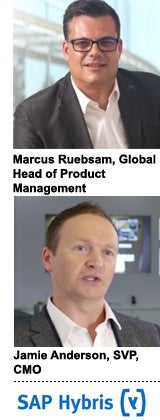
That position will change as SAP begins to fuse SAP XM’s capabilities into the rest of its product set later this year, said Marcus Ruebsam, the global head of product management for SAP Hybris who oversees strategy and corporate development for SAP’s marketing and commerce business.
One thing to expect: SAP’s DMP in XM will be more than just an aggregator of third-party audience data. “Our data management layer has to be tied into all different applications to drive real-time personalization, not just acquire advertising,” Walker said.
AdExchanger caught up with Ruebsam and Jamie Anderson, the SVP and CMO of SAP Hybris, Thursday at the SAP Hybris Americas Summit in Ft. Lauderdale, Fla.
AdExchanger: Instead of acquiring a data management platform (DMP) like some of your competitors, you built one. Will your strategy ever change here?
MARCUS RUEBSAM: There are always two choices when you acquire. Either you acquire for technology to fill a gap. Or you acquire market share. There’s not a lot left [in market] to acquire with large market share. The reason we never saw a [traditional] DMP as part of our portfolio was because we wanted to fix the fundamental problem of managing customer data for our clients, and we don’t distinguish between first-, second- and third-party data.

Our view is companies will use our data management capabilities so they don’t have to go outside to third parties and subscribe to multiple data sources. I believe the DMP itself will become a commodity.
JAMIE ANDERSON: We don’t acquire technology just to fill a gap because you [run the risk of] it becoming a commodity. We’re trying to bring smart people into the business and we think the impact people have on a business can completely offset the value of the acquisition. If you acquire technology companies for technology’s sake, then you risk losing people. But if you acquire companies because you’ve done due diligence and there’s something special about the way people approach a concept or their culture, it’s something that goes right to the heart of SAP’s business.
How would SAP answer critics that argue you’re the last of the enterprise companies to acquire or otherwise invest in ad tech?
ANDERSON: I think we have a very measured approach. There are tons of companies out there. But what we’re looking for goes beyond acquiring pieces of a puzzle. That’s why we encourage a lot of intrapreneurship with our SAP XM business. We look at where there are gaps in our portfolio like any business, but I’d say we’re very pragmatic and not very emotional about these things. We never felt a need to keep up with the Joneses. I’m not [directly] involved in [underwriting acquisition deals], but what it is clear is we do things in a very organic way, when it makes sense.
How do you plan to integrate your XM business with SAP’s broader portfolio?
RUEBSAM: Right now it’s incubated as one of SAP’s intrapreneurships, and we are quite supportive of it. We tend to take people out of our org who have an idea, put them into an intrapreneurship and then later on, if it makes sense, we can release it as part of our portfolio. I think this time next year, you will see it become more of our [overall] advertising platform. It’s quite disruptive, where they’re onboarding publishers and advertisers, to where we can make SAP a platform offering through our other solutions. We are thinking a lot about this at the moment.
SAP has talked a lot about data being at the core of your business. How can clients activate data differently with SAP?
RUEBSAM: There could be B2B companies that predominantly have first-party data or large retailers or consumer product goods companies who want to use everything [from shopper data] down to demographic data, or connect data through their DMP.
We’re able to create a relationship graph where we take an open approach to connect all these data flows and touch points, backed by machine-learning capabilities. We launched Hybris Profile [as part of our SAP Hybris Marketing platform last year] and it’s how we match identities, find similar audiences and it feeds into all our application pillars, such as commerce, website personalization, real-time marketing, sales, service. It’s built around contextualized, real-time data.
How has the SAP buyer persona shifted?
ANDERSON: SAP has traditionally been a staple of the office of the CIO. But this goes back five to six years or more. I think that the evolution to cloud technology kind of freed up something that had been locked down by IT. I think that has been a transformational thing.
It forced people like SAP to really understand who is the end customer? We arranged our solutions by line of business – sales, marketing, commerce, etc. – and we don’t so much market products anymore, but solutions to business problems that address CFOs, CMOs, the chief digital officer. When the buying center for technology shifted away from the CIO, the power went to the line of business.
SAP seems to have a sizable partner presence. Will services be an ongoing part of the equation?
ANDERSON: We don’t mandate who you have to work with, but the goal is to create an open ecosystem of development and implementation partners, be it systems integrators, agencies, ISVs, consultants. Customers vote with their feet and ultimately vote with their cash about who they want to work with.
Interview edited for flow and length.