“We didn’t take a broad enough view of our responsibility, and that was a big mistake. It was my mistake, and I’m sorry.”
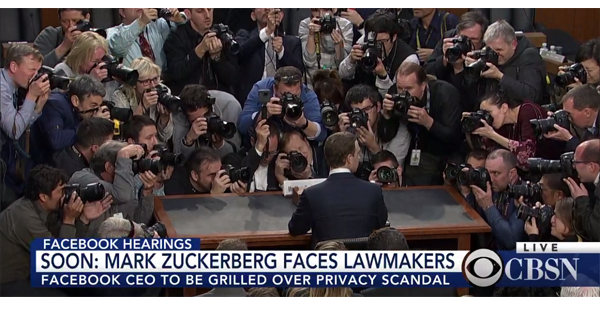
A contrite yet confident Mark Zuckerberg, wearing a suit rather than his usual gray T-shirt and jeans, testified Tuesday before a joint hearing of the Senate Judiciary and Commerce committees in Washington, DC.
But the 44 regulators grilling Zuckerberg wanted more than a mea culpa.
“If you and other social media companies don’t get your act in order, none of us are going to have any privacy anymore,” said Sen. Bill Nelson (D-Fla.). “If Facebook and other online companies will [not] or cannot fix privacy invasions, then we are going to have to – we, the Congress.”
Here’s a breakdown of the top questions Zuckerberg fielded from lawmakers. On Wednesday, members of the congressional House Energy and Commerce Committee will get their chance to interrogate him.
Is Facebook responsible for content on its platform?
“We are responsible for the content.”

Facebook collects a massive amount of data from consumers. What is Facebook’s responsibility to inform users about how its data is being used?
“It’s important to tell people exactly how the information they share on Facebook is going to be used. That is why every single time you go to share something on Facebook, whether it’s a photo or a message, there is control right there about who you are going to be sharing it with.
“To the broader point about privacy policies, this gets into an issue that we and others in the technology industry find challenging, which is that long privacy policies are very confusing, and if you make it long and spell out all the details, you probably reduce the percentage of people who read it.”
Why didn’t Facebook ban Cambridge Analytica in 2015, and why weren’t the 87 million impacted users informed back then?
“When we learned in 2015 that Cambridge Analytica had bought data from an app developer on Facebook that people had shared, we did take action. We took the app down and demanded that both the app developer and Cambridge Analytica stop using any data that they had. They told us that they did this. In retrospect, it was clearly a mistake to believe them. We should have followed up and done a full audit. When we heard back from Cambridge Analytica, when they told us they weren’t using the data, we considered it a closed case.”
Do you collect user data through cross-device tracking, and how do you disclose your collection methods? Is that all in the privacy policy?
“I believe we do link people’s accounts between devices in order to make sure Facebook, Instagram and other services can be synced between devices. We try to be exhaustive in the legal documents around the terms of service and privacy policies but, more importantly, we try to include inline controls in plain English people can understand.”
If I choose to terminate my Facebook account, can I bar Facebook or any third party from using the data previously supplied for any purpose whatsoever?
“If you delete your account, we should get rid of all your information.
“A very common misperception about Facebook is that we sell data to advertisers – and we do not sell data to advertisers. Advertisers tell us who they want to reach and then we do the placement, without data ever changing hands and going to the advertiser.”
Will Facebook implement GDPR-like privacy protections around the world?
“Everyone in the world deserves good privacy protection and, regardless of whether we implement the same exact regulation … we are committed to rolling out the affirmative consent and the special controls around sensitive types of technology, like face recognition, required by GDPR around the world.”
Is Facebook a monopoly?
“It certainly doesn’t feel like that to me.”
Why should Facebook be trusted to self-regulate?
“My position is not that there should be no regulation. The real question as the internet becomes more important in people’s lives is what is the right regulation, not whether there should be.”
How is Facebook ensuring political and issue ads are properly disclosed?
“[What we’re doing ] brings advertising online on Facebook to a higher standard than you have on TV or in print media, where there is nowhere you can see all of the TV ads someone is running, whereas you will be able to see on Facebook whether a campaign or third party is sending different messages to different types of people.
“This is an important element of transparency. The other piece is verifying every single advertiser running political or issue ads.”
Does Facebook know how to recognize the difference between legitimate discourse and hate speech?
“We are developing AI tools that can identify certain classes of bad activity proactively and flag it for our team at Facebook. By the end of this year, we are going to have more than 20,000 people working on security and content view. Some problems lend themselves more easily to AI solutions that others. Hate speech is one of the hardest, because determining if something is hate speech is very linguistically nuanced.
“I am optimistic that over a five- to 10-year period, we will have AI that can get into some of the linguistic nuances of different content, but today we are just not there on that.”
Did Facebook’s “Move fast and break things” motto result in some of the problems being aired today?
“Our new motto is ‘Move fast with stable infrastructure,’ which is less sexy. …
“The big mistake we made looking back on this is viewing our responsibility as just building tools rather than viewing our whole responsibility as being whether those tools are used for good.”