

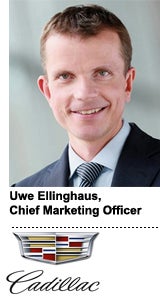
 General Motors’ Cadillac might be a nostalgic brand, but it’s trying to become more relevant to the modern car buyer.
The brand is facing an ongoing sales slump as buyers steer toward the German luxury automakers like BMW and Daimler’s Mercedes-Benz.
“We will not out-German the Germans,” said Uwe Ellinghaus, Cadillac’s chief marketing officer who, ironically, is German. “We recognize that we need to get to the point where we are a distinctive brand that still offers an alternative to the traditional luxury German cars.”
Cadillac’s efforts to distinguish itself as a challenger brand have not been easy. It’s invested heavily in traditional media, though that hasn’t always gone as planned – its 2014 Super Bowl commercial “Poolside” generated unexpected accusations of elitism.
The brand also underwent major logistical changes, relocating its headquarters from the automotive mecca of Detroit to New York last year following a divorce from its Detroit-based agency of record, Lowe Campbell Ewald, in exchange for Publicis Worldwide.
Ellinghaus spoke with AdExchanger about Cadillac’s evolving brand story, the growth of digital media and why he wants to sell experiences, not products.
AdExchanger: What does Cadillac mean to the consumer, or what do you want it to mean?
UWE ELLINGHAUS: Building a brand in the 21st century is far more about storytelling than anything else. “Dare Greatly” is our new brand claim … and it’s really a call to action for us. It’s why you’ve heard so much about all of the changes at General Motors as we develop more of a standalone business for Cadillac and moved the headquarters to New York.

It’s part of a long journey we embarked on over a year ago. The reality is, we have new products that are well received, but it will take years before our brand image will catch up to the substance of the products.
What are your goals?
Cadillac does not have a bad image or a brand awareness problem, but we have not been as relevant to the luxury car buyer since German companies like BMW and Audi dominate the market. Our strategy is not to emulate what the Germans do.
Yes, they make terrific cars, but we are a contemporary American brand and want to increase our relevance. We want the brand to appeal to the entrepreneurial spirit because the old corporate world has no appeal to Generation Y, this idea of taking your destiny into your own hands. Cadillac needs to show that we share the same spirit and mindset of a new generation, not the Cadillac of two decades ago.
How are you accomplishing this?
Opinion proliferates so quickly in the digital era. I want Cadillac to become the new cool for a generation that doesn’t carry the baggage or legacy [of the past]. It’s why I focus my effort on Generation Y and have rededicated more of our budget to digital. More than 70% of new car buyers use the Internet as the main vehicle for insight before they buy a car and we need to meet them there.
How much budget have you moved to digital, and how much of that comes from TV?
I’m not lying to you when I say I can’t give you the precise percentage figure, because it’s hard to quantify. The great thing about digital is it’s not necessarily expensive. Definitely traditional media is still the largest part of my budget but we have increased our digital allocation. The lines are blurring and I struggle to name the percentage because if I produce a creative piece, I may use it digitally or for TV or for mobile.
Do you struggle with brand affinity or is indifference your biggest challenge?
I learned when I worked at BMW and at Montblanc that luxury brands need to appeal to people outside of their target audience. It is about fueling aspirational desire even for people without the means to ever buy your product. And so this is why I totally agree with channeling more efforts in digital. To reach mass audiences I still need traditional media: print, out-of-home and TV.
Luxury brands sell dreams, and products are merely the means to get there. And as you can imagine, that didn’t go down particularly well in automotive Detroit. … But I just believe we need to transcend the boundaries of automotive [and] reach out to Generation Y, incorporate things like fashion and entertainment, their areas of interest. We needed to get out the established sponsorships and platforms highly relevant for baby boomers.
Can you give an example?
We recently announced a branded content partnership with Conde Nast’s [branded content studio 23 Stories] where we share content across their properties and use their knowledge of online subscribers to target our ads to readers’ interest areas vs. buying a bunch of banner ads no one clicks on. I totally believe that branded content – and I’m not referring to advertorials – where we accept the interest of certain prospects and try to target our messages to meet their need vs. providing one standard, one-size-fits-all message, will make us more relevant.
How are you using data to support those efforts?
I don’t like the phrase “big data” because everyone uses it and not everyone knows what they’re doing. We are doing advanced targeting, tracking search and browsing behavior online and applying those toward individual messaging. The automotive industry is a latecomer to applying the proper usage of data to influence something like the online interaction.
I recently hired a CRM manager in New York from Delta Airlines and someone who came from American Express. We want to reach this concept of one view of the customer, so whenever you contact Cadillac, whether it’s call center or email, we can identify you and have a previous record of your actions and purchase intent.
You can have the best product in the world but if someone’s experience at your dealerships or online isn’t good, it doesn’t matter.
The interview has been edited for clarity and length.








