

 What do loyalty programs and paid media have in common?
Not a lot, at face value. Loyalty marketing has long been relegated to card-based, point-of-sale programs and customer retention. It was always the stuff of database marketers and direct mail – not user acquisition.
But that’s starting to change. Coalition loyalty programs or “co-ops,” such as American Express’ Plenti program, aim to bridge the gap between traditional and digital, as well as upper and lower funnel marketing.
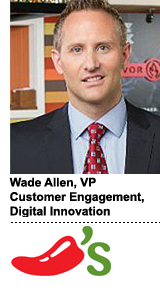
“The industry has always been chasing this notion of, ‘How do I get the reach and frequency of media, but with an efficiency play like I do in direct marketing?’” said Wade Allen, VP of customer engagement and digital innovation for Brinker International’s casual dining brand Chili’s. “Plenti addresses this.”
The popular Tex-Mex-inspired dining establishment with 1,550 restaurants globally is the latest entrant to AmEx’s Plenti program, joining fellow coalition members Hulu, AT&T, Rite Aid and Macy’s, among others.
Plenti doesn’t disclose membership other than to say it’s in the “millions.” For Chili’s, whose My Chili’s Rewards program is 4.6 million members strong and less than a year old, there is a new opportunity for audience extension.
Allen spoke with AdExchanger about the new uses of loyalty.
AdExchanger: Why did Chili’s join Plenti?
WADE ALLEN: It gives us more access to guests who perhaps weren’t in our consideration set previously. Now they can get a free meal at Chili’s because they earned all these points at Rite Aid or AT&T. The ability to be a net (loyalty) redeemer was a light bulb moment for us.

Does the program create a network effect with data for partner brands?
It absolutely is a big benefit. All data is anonymized and we’re not looking at personally identifiable information, but we are getting the ability to segment in these very targeted fashions – for example, families that may have the propensity for this type of transaction. So you get the reach and frequency of media, but a very targeted segment of people who, birds of flock and feather go together.
I worked with dunnhumby [a data company originating from Tesco’s club card program] in the US in the past, and there are a lot of former dunnhumby people in the Plenti program now, so there’s a lot of trust with what they’re doing from the analytics and segmentation side.
What’s the biggest change in retail/shopper marketing since your dunnhumby days?
The struggle early on with retailers/ restaurants in terms of shopper marketing dollars was there was no efficient way to [apply] data-[driven insights] to a consumer in a timely fashion. Fast forward 20 years and you have all this rich transactional data but also the means now to communicate with a consumer immediately and efficiently.
How is that shifting shopper marketing dollars?
As we work through “loyalty 2.0” with these other partners, we realize we may be able to satisfy guests with a meal, but maybe the next transaction is at Exxon [another Plenti member]. You start to see that if we link all these systems and data together, the immediacy of what we’re able to do only enhances the guest experiences across partner brands.
Digital has changed the immediacy of everything – text, email, push notifications. How different than a postcard that comes three weeks later from [a grocer] telling me the great things I should go back and buy at the store.
Is loyalty now part of new user acquisition?
We still think our “best” or most loyal guests will pre-select us and opt into My Chili’s Rewards and about 18-20% of total transactions that happen during the day will be associated with a “loyal” group of people. But our hope is by hooking our train to Plenti, we’re finding new customers on a mass media scale who we can bring in through new offers. So it is an acquisition-based strategy using direct marketing tactics like email, direct mail, mobile push notifications.
What’s Chili’s focusing on with mobile?
We included the rewards capability within our core mobile application and we kind of take this position of, “Mobile is for me and digital/web is for all.” We try to put personalized information in the mobile app and loyalty is one of those pieces that’s very personal to you and I because it has your points balances, the items you’ve ordered, what bonus offers we’ve participated in. We’ve added other features, [like the ability to] geoselect a restaurant and determine the wait time or get into the wait queue. It helps foster consideration.
What do your retail brethren struggle most with in developing app experiences?
You have to identify the business opportunity first. Gone are the days of just putting an app out there that does exactly what the website does. For us, we had to ask, what was the purpose of the mobile app? It was all around building personalization and relevance. If we didn’t enable elements like geolocation for a restaurant, checking your loyalty balance or letting you redeem points through a QR code or a Ziosk [tabletop ordering system] in the restaurant, then it’s wasted opportunity because you’ve become redundant in two channels.
There’s a very clear delineation between digital and mobile, in our opinion. One of the key initiatives I took on at Chili’s was rethinking what “atmosphere” really means and that extends well beyond our four walls to digital guest experience, CRM, mobile.
What’s a key trend Chili’s is watching in the coming year?
It will be interesting to see the use of passes inside the mobile wallet. We use it when we fly around the country and when we scan our boarding passes, but there’s something there around the functionality to either incentivize the guest, keep that brand in-hand and in-wallet outside of the mobile app they’ve downloaded. And also to redeem loyalty points or tap into some other kind of mechanism. We’re working on more of those “tap-in” components.
This interview has been edited for clarity and length.








