 More than 32,000 will congregate in Cologne, Germany, this week to spark a dialogue about the connected consumer and the state of the digital media economy.
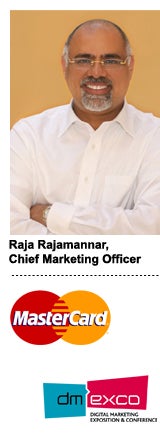
Among those gathered here will be MasterCard’s chief marketing officer, Raja Rajamannar, who will join a bevy of global agency and platform execs at the yearly Digital Marketing Exposition and Conference (DMEXCO).
“In the last two years, digital as a percent of our total media spend has tripled and, over the next three years, I expect digital to significantly outpace our traditional media spend,” Rajamannar told AdExchanger on the eve of the big show. MasterCard’s domestic media spend was about $118.2 million in 2014, according to Kantar Media estimates.
Although he declined to share the specific amount the brand will reallocate to digital, MasterCard and other advertisers are paring down their traditional media expenditures.
“For me, there is no more instance of prime time,” he explained. “I need to recognize that a consumer is looking at a small screen while they’re watching TV, which will play a supporting role in his or her consumption. Therefore the ads must be different, yet harmonious. We are talking very differently about how we communicate with consumers now.”
Rajamannar spoke with AdExchanger about the changing buyer landscape and where MasterCard is focusing its marketing investments.
AdExchanger: How have new patterns of media consumption impacted your marketing strategy at MasterCard?
RAJA RAJAMANNAR: We’re a digital product, so changes in the digital space have a profound impact on our product itself. On the other hand, we also use the opportunity of the highly connected consumer as a marketing opportunity. Today, the purchase funnel is completely reversed. It’s not linear at all.

A couple of years ago, we would give consumers benefits and discounts and coupons to stimulate their interest and attention, but today it’s a totally different picture. Experiences matter to consumers more than things. Our company happens to be in financial services and technology, but we’re an experiential brand.
How has this changed your positioning and, conversely, your media investments?
Our brand positioning years back was “the best way to pay.” Now, we’re focused on connecting people to “priceless possibilities.” We are shifting significantly toward digital video, which impacts our budget allocation pretty substantially. There are still questions about a common measurement, metrics and what will be the standard metric. But for a company like MasterCard, we have … data about buyer behavior at an aggregate and anonymized level, data that is very insightful to be able to say, “I can reach this consumer for this particular campaign in this particular channel at this time.”
How is the convergence of TV, video and over-the-top changing your budget allocation?
TV is by far the medium that gives you the most scale in a reasonably economical fashion. TV is not going away in the near future and in countries outside of the US that’s even more the case. Having said that, the role of TV – digital video and TV combined – will need to be complementary. It has to be to have a collective impact. TV will not disappear. Will it continue to grow, but become more addressable? Absolutely yes.
MasterCard’s been very vocal about programmatic media buying. How does data influence your allocation?
It lends itself very well to digital, but my prognosis is that it can be applied in digital out of home, addressable TV and with radio. Programmatic will become more significant in the future. For someone like MasterCard, we have tripled our digital investment in the last three years. With programmatic being critical to digital, programmatic becomes therefore more important in my overall marketing plan.
Programmatic however is not the be-all, end-all. It is one tool and methodology to optimize your media buying in real time. There is so much more outside of it. When I think about experiential marketing, and giving experiences to consumers – through a platform we call Priceless Surprises –programmatic is not equally relevant in that environment.
How has your relationship with agencies changed the most?
One thing I personally believe is that you need to have your agency be your partner. As we learn and develop, we have to take them with us and vice versa. Today we talk about so many microchannels where we’re connecting with the consumer, that it requires agency teams and client-side teams to sit together. … It’s important to transform the way we interact with each other, it requires a very high level of engagement. If you want to understand a consumer’s perception and behavior as it relates to consumption and commerce, you have to get into other aspects of his or her life and have deep, human understanding.
This interview has been edited for clarity and length.