 In 2014, Nestle Waters’ data was spread across different digital agencies and databases.
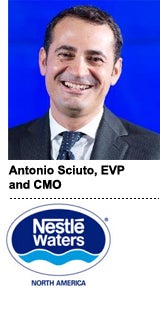
“Our go-to-market strategy was very complex,” said Antonio Sciuto, EVP and CMO of Nestle Waters North America.
Because Nestle Waters sold its beverages online as well as straight to stores, through single-serve machines or in bulk to warehouses, the company’s digital and offline strategies had to merge, Sciuto said.
Sciuto, who used to be global head of ecommerce, saw his purview expand to e-business, consumer insights and innovation when he became CMO two years ago.
Nestle Waters also dedicated an entire team to consumer experience, tasked with walking the line between agency and brand activation units.
Lately, Nestle Waters is emphasizing “real-time” data its marketers gather from the social firehose at a digital engagement center it staffs with Salesforce.
The CPG brand wants to chart people’s relationship with a bottle of Perrier or Pellegrino – and develop branded content backed by data to boot.
Sciuto spoke with AdExchanger about Nestle Waters’ evolving data and content strategy.
AdExchanger: Why did you bring together e-business, offline and digital marketing?
ANTONIO SCIUTO: We’ve had a system established at Nestle Waters to go direct-to-consumer for a long period of time. The digital revolution is providing more opportunity to use a different piece of content at different steps in the consumer journey. Obviously, retail and the direct-to-consumer business are just two of those touch points, and we needed to be sure we are ready with content that’s aligned with our brand strategy. Branded content is the new advertising – and this is the ongoing challenge.

How has your relationship with agencies changed?
It’s not changing as much as I personally would like it to. I always say the marketing office is not changing. The role of the creative agencies is not fully changing, but there is not one way to create great content or good campaigns anymore. Traditionally, it could take Nestle Waters between six to 12 months to deliver a great campaign, but now there are different content models and different partners. Our time to go live with a campaign can be reduced [down to two to three months]. There is no one right way to create content.
How has the fusion of paid media and CRM impacted Nestle Waters?
We traditionally identified our consumer target for media based on demographics, their general media consumption and what are the brand objectives and strategy. This strategy shoots for more eyeballs and impressions likely to engage with your brand.
But using first- and third-party data to improve reach while also knowing the consumers who are engaging with your brands because they are reacting to campaigns or subscribing to your programs gives you better understanding. And through lookalike modeling, you can continue to improve your media model and drive effectiveness in the marketplace. When you have that data, you can make your content more effective or trigger the next action, which could be clicking through or engaging with another piece of content.
How are you gauging the ROI on content, which seems much more qualitative than measuring the CTR of a display ad?
People should always remember that the key metric really driving success is always brand health. If the media effort is not driving improvements in brand health, this is crazy. The risk today is that with all the rich metrics that are available, marketers can forget why we do all we do. Measurements that are much more related to the media side – click-through rate, completion rate in video – are critical measures of success in digital, but then you have positive vs. negative social sentiment, share of voice and engagement.
But beyond that, the data related to artificial intelligence or predictive intelligence is really something that requires much more focus in the near future with our emphasis on Internet of Things. When you have the pressures of the business, you don’t always have the privilege to dedicate time to things that are really fascinating to me.
You’ve mentioned before that Amazon is an important distribution platform for some of your brands, like San Pellegrino. How has your relationship with Amazon evolved as they’ve pushed more media than pure-play ecommerce?
Amazon plays an amazing role in the US ecosystem, because it’s not only a retailer or media channel, but it is becoming the most important search engine in the US. The way consumers use Amazon is challenging companies to have the best content possible.
It’s not about product names, descriptions or images anymore. It can become a place you can really create a brand experience providing additional information through videos that can really break shopping barriers and traditional relations with the brand. I think if you go on Amazon and look at San Pellegrino beverages, it gives you an example of what good content looks like on Amazon. They now have different experiences for mobile and web.
What are you dedicating your experimental budget to?
We used to think of innovation in terms of targeting, but innovation is your business model, the way you activate relationships with consumers. It’s about different ecommerce models or different media channels. When we look at our white-space opportunities, it’s technology, emerging media channels taking advantage of new business models.
The interview has been edited for clarity and length.