
 The auto industry, ever competitive when it comes to traditional advertising, has brought that competition to programmatic buying. By leveraging data from car makers and dealers, brands are able to target and optimize their digital advertising through data-driven programmatic, and the competition is heating up in that space.
According to data released by DSP and DMP Turn, price competition among auto companies was at an all-time high in early 2015 and has since stabilized. Turn’s Advertising Intelligence Report 2015 tracks data from the Herfindahl-Hirschman Index (HHI), which measures the level of competition, against spend data from the Turn platform.

“It’s always been a competitive space, but there’s been volatility within that,” said Maxwell Knight, VP of marketing science services at Turn. “If you look back to mid-2014, it’s relatively competitive compared to many other industries, but the range of that index swings quite a bit. When you look at what’s happening … in 2015, it’s pointing to more competition and as it varies, it varies less than it has in the past.”
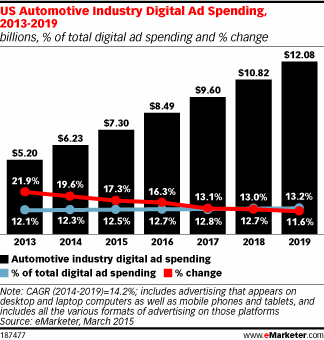
Overall, the automotive industry is one of the top digital ad spenders, below retail, according to May data from eMarketer. The researcher predicted the auto industry will spend $7.3 billion on digital advertising this year, and that figure will rise to more than $12 billion by 2019.
Within that digital spending, programmatic is starting to become a staple for many automotive advertisers.
Turn says there was a definite drop in the HHI in January 2014 for the automotive market, which means there was more competition during that time. The HHI has stayed low, especially compared to the previous HHI that Turn analyzed, and the swings are smaller compared to data in late 2014.

Across industries and platforms globally, Turn found that the Americas had the most consistent competition and spend in programmatic. Meanwhile, display has stabilized in EMEA and started to reach maturity in APAC, but the other platforms have room to grow.
“In Europe, we see that brand marketers are increasingly spending on programmatic buying and using it for brand objectives, which is something you didn’t really see a year ago,” said Samantha Merlivat, programmatic analyst for Europe at Forrester.
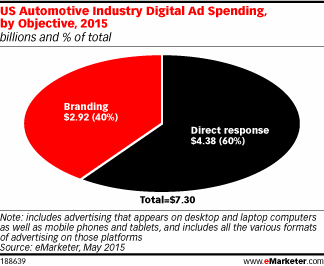
The auto sector is one of the top industries for direct response advertising. EMarketer said 60% of digital spending in the industry was for direct-response advertising, and 40% went to brand advertising. This was only behind travel and financial services industries.
“Programmatic has been around a while now; people are getting more comfortable with it,” Knight said. “Now everybody is getting their hands into programmatic. People servicing the automotive industry, like agencies and media services companies, have gotten more adept at running different tiers of auto business in the programmatic space.”
Programmatic video is one key frontier for car companies. Online video company Innovid transacts more volume of advertising for car companies than for any other vertical, according to CTO Tal Chalozin. One of Innovid’s clients is Chrysler and the two companies recently debuted a new programmatic initiative that connects consumer data to over-the-top content devices such as AppleTV or Roku.
“For Hulu, 60% of their viewership is done on a connected TV,” Chalozin said. “The problem is that you don’t do browsing on those devices, so you lose that data.” Innovid helped Chrysler create audience segments at a household level, for instance by allowing the brand to leverage user interactions on Cars.com to target video ads on Hulu.
Such advanced segmentation and reach measurement across devices is the future for car makers, according to Turn’s Knight, but it’s still early days.
“Obviously when you’re dealing with automotive brands, segmentation is massively important,” he said. “There is a lot of nuance that a good media buyer or media services professional can bring to automotive brands, utilizing these audience features, and that’s one of the things that programmatic is all about.”







