Shaina Boone will discuss viewability, fraud and supply chain issues on April 14 at PROGRAMMATIC.IO in San Francisco.
Talking about fraud and viewability is one thing – but “actually managing it is an entire program,” said Shaina Boone, managing director of marketing sciences at OMD USA, where she helms the analytics practice.
Managing advertiser expectations is particularly challenging. The Interactive Advertising Bureau’s 70% threshold is a good example. In December 2014, the IAB declared that while 100% viewability isn’t yet technically feasible, the industry should be able to attain 70% viewability on measured impressions.
“The IAB says the viewability target is 70%, but the reality is that it’s more like 50%, and that causes some stress between us and the client,” Boone said. “It’s just not achievable in many cases.”
Advertisers also don’t take too kindly to being asked to pay more for viewable impressions.
“Publishers that want to comply with viewability can just make everything more expensive – which is actually closer to what the price should have been in the first place,” Boone said. “In essence, advertisers have been getting a discount this whole time – but if you want premium inventory, the price is going to go up.”
AdExchanger caught up with Boone to talk about the tangled web that viewability compliance weaves.
AdExchanger: Does programmatic pose any viewability challenges?
SHAINA BOONE: Probably only about 50% of the programmatic media we’re running ends up being measurable by our viewability and fraud tools. Display isn’t a problem, but we had to switch video ad servers to get better viewability. You’re only getting a slice of the truth.

Then how do you know what’s going on?
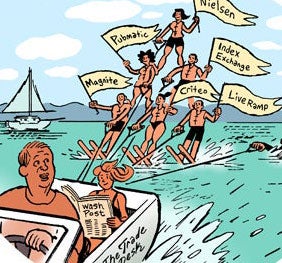
Well, you don’t. The whole industry is built on the fact that everyone is taking a cut from everyone else, and that creates holes and opportunities for people to take advantage of a complicated system. The landscape of content is so vast that you can’t monitor it all to know whether people are being truthful.
What are some rules of thumb for choosing a viewability vendor?
Honestly, a big part of the evaluation comes down to the way their salespeople handle themselves and how they talk to us about how their technology works. If they’re too covert or secretive about it, we have to eliminate them.
Another critical part is their blocking capability – that’s how we calculate the ROI of the tool. We know how much we’re spending on the tool and how much impressions cost, so the number of ads a tool can block in a pre-bid environment shows us the return on investment.
What goes into implementing a viewability solution?
It’s not out of the box. We’ve actually created an implementation checklist and our vendor provides us with quite a bit of support. Really, it’s more about getting the publishers to agree to place the tags in the first place. That’s where there can be resistance, and in other countries even more so. In China, for example, we can’t get even half of the publishers to agree to place the tags.
How do you woo publishers?
The initial step is writing the RFP to include viewability or fraud standards and benchmarks, which is a whole ordeal unto itself. Then we negotiate. If they don’t like the targets we want to hit, they can decide not to work with us. There is a tension in setting up the partnership.
When they agree, we proceed with the implementation and, as with anything, it’s yet another tag that we’re adding to all sorts of different pieces of media that in many cases aren’t even measurable. We have particular trouble with mobile.
Is the industry ready to tackle mobile viewability?
I don’t think so. We’re still barely doing it well on the desktop side. There are so many problems with mobile in general. For one, a lot of the clicks that are happening are accidental – fat thumbs – and just the screen size alone screws everything up.
Back to publishers, it seems like they’re getting the short end of the stick. They’re required to integrate with whatever vendor the advertiser demands and they’re held responsible for reconciling and makegoods.
It’s unfortunate that they’re the guys that keep getting kicked, but you could also say that they’ve been complacent all along and didn’t fix anything proactively. It’s not as if they haven’t been aware of this.
What’s your take on the transparency issues that triggered last year’s spate of media reviews?
You don’t buy a car and get half the car. If you pay for it, you should get it. It’s not, “We’re sorry, but the wheels aren’t included in this model.” The only way things might change is if people start to get audited and fined. But changing the infrastructure of an industry is a gigantic undertaking. There are some very large challenges ahead.