

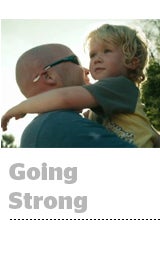
 It’s becoming acceptable for men to moisturize – and Unilever is very happy about that.
“I’m also happy the world is recognizing that men should be portrayed as parents, as bright human beings and not just bumbling idiots,” said Kathy O’Brien, VP of skin and marketing services at Unilever, speaking at the ANA’s Brand Masters show in California on Thursday.
About eight years ago Unilever-owned Dove, known as an iconically female-focused brand – think Real Beauty – decided to take the plunge and address masculinity with Dove Men + Care, a new product line aimed at men.
O’Brien knew that 40% of Dove bar users were already men, so she wasn’t too worried, but the challenge was clear.
“We have to make the brand feel masculine, and eight years ago that seemed a lot easier,” she said. “I remember sifting through the data and one key fact stood out: If I just put four men on the pack, purchase interest among men would go up 31%. I thought, this is going to be really easy.”
But the notion of what it means to be masculine has changed drastically over the past decade – and it was going to take a lot more than changing packaging to move the needle.

A Unilever study found that nine out of 10 men felt that “showing their caring side” is a sign of real strength and masculinity – a global insight that applied to men in the US, UK, China, Brazil and Germany. But only about 7% of men around the world thought masculinity was being accurately represented in the media. That said, 89% of men felt that the concept of masculinity has changed since their father’s generation and 90% believed that showing their caring side is a sign of true strength.
From there, Dove built a strategy to take advantage of the wide gap between need and perception: a combination of people-based marketing with a rigorous focus on brand and product that leveraged everything from 30-second TV spots and longer-form digital videos to research and social media.
“But they all have a common thread, to reflect the relevant experiences men care about in their lives and do our best to meet men wherever they are in their lives. We’re increasingly seeing men who want to know more about brands, to understand their personalities, what makes them tick,” O’Brien said. “There’s a certain creativity and artistry involved in crafting brands so they meet men’s reality.”
For example, although Dove Men + Care doesn’t usually get involved with celebrity endorsements, Unilever decided to partner with sports icons like Magic Johnson and Shaquille O’Neal in 2011. But Dove didn’t speak to them about their sports-related accomplishments; rather, the brand talked to them about being dads and their relationship with their own fathers.
Dove distributed its content beyond traditional TV spots, serving it up in mobile and digital bites that would “allow men to absorb the content when it was most appropriate,” said O’Brien, noting that Dove was an early adopter of Viggle, a second-screen app that connects mobile usage and TV viewing to reach men on their phones while they’re watching sporting events.
Most recently, Unilever took advantage of the Super Bowl with its #RealStrength campaign. Dove seeded the hashtag with NFL players in the lead-up to the big game to give its tear-jerking Super Bowl ad, which depicts proud fathers taking care of their children at various life stages, more “real-time relevance beyond just seeing the commercial,” O’Brien said. Dove also purchased a home page takeover of cnn.com the morning after the Super Bowl.
“The Super Bowl has changed from, ‘Do you have enough money to put an ad on,’ to now, when we spend months talking about how we’re going to build up to the Super Bowl … and what can we do to leverage and try and get post-Super Bowl buzz at least for a couple of weeks after to really make the spend worthwhile,” she said.
#RealStrength garnered a fair amount of media attention and organic shoutouts from football players, ESPN and the editor-in-chief of USA Today. Dove’s spot garnered 2 million engagements on Twitter during the Super Bowl and Dove trended nationally following the release of the spot.
“Dove Men + Care is the fastest-growing brand at Unilever since we launched five years ago,” O’Brien said. “We’re helping encourage a shift in the acknowledgment of men as dads, but there’s still a ton of work to do.”







