 “Data-Driven Thinking” is written by members of the media community and contains fresh ideas on the digital revolution in media.
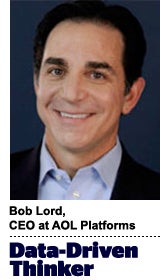
Today’s column is written by Bob Lord, CEO at AOL Platforms.
The annual whirlwind of Advertising Week events, when nearly 100,000 advertisers, agencies, media and marketing companies converge in New York, always presents a fantastic opportunity to take stock of our industry and where it’s headed.
There was a different vibe in the air this year. Although the digital revolution has been reshaping the marketing world for well over a decade now, as recently as one year ago few could even define what programmatic means.
Technology has traditionally taken a back seat to the glamour of creative strategy and TV upfronts. A great deal of confusion still exists about how to effectively tap into the proliferation of IT offerings available to buy, sell, optimize and measure ads.

On the heels of many great conversations with advertisers, agency heads, media execs and others this week, it’s been exciting to see technology and innovation move to center stage. Here’s my take on some of 2014’s notable highlights:
Leaning In To Programmatic
When The Wall Street Journal posts a blog titled “Welcome to (Programmatic) Advertising Week,” you know something fundamental has shifted. WSJ noted there were more than 20 panels on programmatic technologies this year at Advertising Week. If last year was about education – with the few discussions taking place focused on “programmatic 101” – this year was about how to optimize and extend use of programmatic tools beyond RTB, bringing automation to premium campaigns and across multiple channels.
Early adopters are now broadening their use of programmatic while more and more newcomers are jumping onboard. MAGNA GLOBAL released a study this week on programmatic spending and the numbers speak volumes: Of more than 35 countries analyzed, the amount of media inventory transacted programmatically will reach an estimated $21 billion globally this year, a 52% increase compared to 2013, and $53 billion by 2018.
The industry sees the writing on the wall. Programmatic technology will drive the ongoing mechanization of advertising, as the efficiency of automation continues to wean people off of multiple meetings and manual insertion orders.
Convergence Is Coming – For TV And Digital
The ongoing evolution of programmatic technology, combined with rapidly changing media consumption habits, is already blurring the perceived boundaries between the worlds of digital advertising and linear TV. On Monday at Advertising Week, NBCUniversal announced NBCUx, which will open some of its digital display, mobile and video inventory to programmatic buying. This is a harbinger of where the future is headed, as programmatic technologies demonstrate their potential to give advertisers much deeper insight into audiences across all channels, including TV, at scale.
“Today, convergence is the new reality,” said Linda Yaccarino, president of advertising sales at NBCUniversal. “Programmatic is here to stay.”
Data: The Most Valuable Asset
This week, data has been called the “new oil,” “the next battleground” and the most important component of advertising’s present and future. I say amen to that.
Data is an invaluable asset that can be used to continually refine media strategies and inform real-time decisions around specific types of inventory, reach, frequency and more.
Data is “one of [ESPN’s] greatest priorities over the next 18 months,” Eric Johnson, ESPN’s executive vice president of global multimedia sales, said during a panel moderated by Sir Martin Sorrell, WPP’s chief executive.
Making the most of the enormous volumes of data now at our fingertips will require a commitment to open, connected systems that support the integration and holistic analysis of critical information across screens, devices and types of inventory. And the power of programmatic data to define the when and where of strategic ad placement is only step one. Next, marketers need to be thinking about how to effectively leverage data to overlay the most compelling creative on top.
Accurate, real-time, cross-screen data is the fuel that will drive maximum engagement, lift and ROI.
Follow Bob Lord (@rwlord), AOL Platforms (@AOLPlatforms) and AdExchanger (@adexchanger) on Twitter.