
 “Data-Driven Thinking” is written by members of the media community and contains fresh ideas on the digital revolution in media.
Today’s column is written by Rajiv Maheshwari, mobile technology leader at Neustar.
Regardless of the many innovations in the ad tech industry, the perspective continues to be heavily skewed by display advertising and its foundation built on impressions, clicks and conversions.
Mobile has awesome characteristics, including mobility, location context, environment context, a more personalized nature, a user-friendly form factor and a rich user interface capable of audio, visual and sensory interaction. However, mobile is often generalized to apps versus browsers and pigeonholed to fit within the omnichannel story, as yet another channel. Mobile is not just about apps. Mobile deserves individual attention and strategic focus.
Continuing Strong Growth
According to Internet Retailer’s newly published 2016 Mobile 500 report, mobile commerce represents 30% of all US ecommerce, with sales totaling $104.05 billion, up 38.7% from $75.03 billion in 2014. Mobile commerce is growing much faster in Asia, Europe and Latin America.

“Mobile firmly established itself as the dominant shopping trend, for both traffic and sales,” Fernando Madeira, president and CEO of Walmart.com, said in a statement on Dec. 1. “Mobile is making up more than 70% of traffic to Walmart.com, and now nearly half of our orders since Thanksgiving have been placed on a mobile device – that’s double compared to last year. Our customers went from previously mostly searching and browsing on mobile to making purchases at a much higher rate.”
Walmart’s endorsement points to the democratization of mobile’s lead.
Death Of Desktops
Worldwide PC shipments fell 11.8% year over year to 66.1 million units in the second quarter of 2015, according to IDC, the biggest drop in nearly two years. Apple sold 61 million iPhones during the same quarter.
Desktop and mobile are converging. IPad Pro is blurring the lines between tablets and PCs. Traditionally separate desktop and mobile applications are converging toward cloud-based applications. Microsoft’s Windows 10 universal app platform aims to support such applications. In addition, computational power, memory and graphical capabilities of smartphones are approaching those of the average desktop PC.
It would not be a stretch to imagine that in the near future one could walk up to a display device, keyboard or mouse anywhere in the world and expect it to transform into a wireless PC powered by one’s smartphone. Mobile or cloud apps could be used, with all data residing on the smartphone or in the cloud. A setup like this will bring true workspace mobility.
While desktop PCs may continue to be used for high-end applications, mobile devices and apps will dominate the user experience.
More Than A Portable Phone And Computing Device
Smartphones displaced portable media players with their ability to deliver live streaming content. The latest generation of smartphones are packed with a bevy of advanced sensors that enable them to morph into all types of other devices.
A fingerprint sensor transforms the phone into an authentication device and also lets it function as a payment device. GPS chip and mapping apps enable the phone to become a navigation device. Accelerometer and gyroscope enable the phone as a gaming device or controller for other gaming devices.
Several third-party accessory devices integrate with the smartphone and transform it into a device for other advanced applications such as, health and fitness tracking, augmented realit, and virtual reality.
These are just few examples of how significantly smartphones are integrated into our lives.
Internet Of Things
The promise of the Internet of Things (IoT) is eventually every useful thing we interact with, including the environment, will be embedded with “smart” capabilities enabled by all kinds of sensors.
Everything, including our clothes, appliances, devices for work and entertainment, furniture and buildings, will be embedded with sensors that collect and transmit useful data. Smart applications will process the data and present relevant information and services to the users, as well as store information for later retrieval and analytics and, in many cases, automatically trigger appropriate action.
The majority of the embedded sensors will be in low-power and inexpensive devices that do not need servicing or replacement in their expected lifetimes. Some may be battery operated but many may use alternative sources of energy, such as light, vibration or heat; these are the so-called energy-harvesting devices.
Many of the envisioned IoT applications will not need the sensory devices to have continuous network connectivity. The sensory device may be designed to wake up or be woken up, occasionally for transmitting short burst of data. Hence, it is unlikely that embedded devices will have iOS or Android running them or a Wi-Fi chip to hook up to the Internet.
With smartphones supporting a growing number of communication protocols, including Wi-Fi protocols, Bluetooth and NFC, it is reasonable to expect embedded sensors to leverage smartphones’ advanced hardware and software capabilities, security and individual privacy.
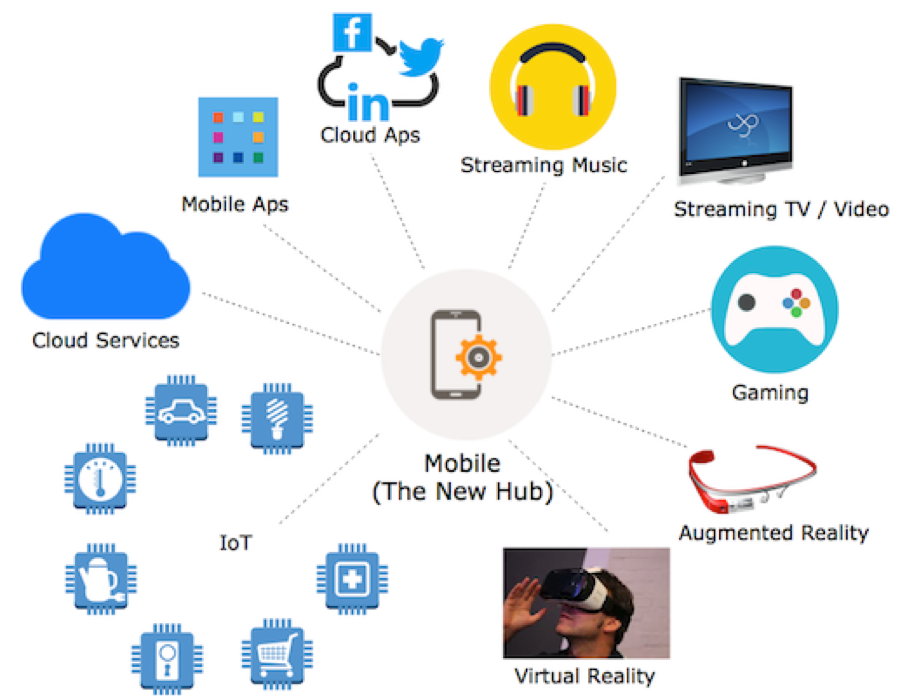
Smartphone Is The New Hub
Thanks to Bill Gates’ vision of a PC in every home and on every work desk, the PC became a hub for everything. PCs democratized computing and empowered people. Well, PCs had a good run.
The smartphone is taking over as the new hub for everything. It is not to say that smartphones would remain the hub for all things to come and not get replaced by something else. However, most likely we will be unable to sidestep smartphones as the mobile hub in the evolution process. Ad tech companies must have a solid mobile strategy.
Follow Neustar (@Neustar) on Twitter and AdExchanger (@adexchanger) on Twitter.








