
 “Data Driven Thinking” is written by members of the media community and contains fresh ideas on the digital revolution in media.
Today’s column is written by David Shapiro, vice president of corporate development at DataXu.
In the four years real-time bidding has been commercially available, it has emerged as one of the industry’s fastest-growing technologies. RTB adoption, frankly, rivals the adoption of other long-lasting and hugely significant technological trends, such as the proliferation of Wi-Fi, Google’s explosion in search, the growth of mobile phones and even the adoption of the iPhone.
What have we seen over this brief period of time? An open standard, the birth of a market, testing and trialing at a widespread level, skyrocketing growth, some pitfalls along the way (bots!) and finally acceptance and rapid adoption. It sounds like a roller coaster ride, doesn’t it?
What else looks a bit like a technological roller coaster? It’s the enterprise’s old friend, the Gartner Hype Cycle. Let’s revisit it, and plot RTB on its curve.

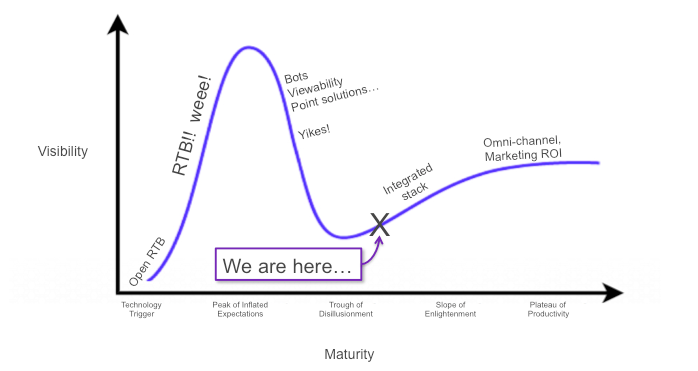
This isn’t an exact match, of course. And I think we’d all acknowledge that there hasn’t been any kind of trough. Nonetheless, the chart may be helpful as we take a step back from the frenetic growth of these markets.
Judging from the Gartner Hype Cycle, it is clear that RTB technology is not only here to stay, but seems poised to eclipse purchasing media via non-programmatic means. What are the implications of this?
1. What Worked In The Past Won’t Work In The Future
Enterprises must adopt new ways of working to best accommodate the technological impact of programmatic buying. The proverbial toothpaste is out of the tube, and the enterprises that recognize this now will be best positioned to capitalize on it in the years ahead. Don’t wait for your competitors to benefit from programmatic marketing while you wait for others in your organization or agency to figure out if it is a real, sustainable trend. It is.
2. Embrace Transparency
One of the follow-on benefits of programmatic marketing is the control it gives to the end advertiser. No longer do brands and their agencies have to be beholden to the opaque business models of yesterday’s ad networks. Instead, for the first time, RTB and DSP technologies enable advertisers to see ad activity on an impression-level basis. This data transparency is clearly good for advertisers. In this changed environment, enterprises and advertisers should not only hope for increased visibility into their digital marketing activities and campaigns, they should require it.
3. Free The Data
RTB enables impression-level decisioning and data, so absolutely leverage it to optimize your media. But also be informed by it. Programmatic marketing allows you to see more precisely what’s working, where and why. It also sheds light on how your prospects are engaging with your marketing programs across channels, device types, geography, time of day or almost any data field you want. So, let this new data paradigm enlighten and inform you across the spectrum of your digital investments and customer segments.
4. Look To An Integrated Stack To Derive The Most Benefit
If we look across other technology adoption curves, what often follows major technological disruptions is a proliferation of point solutions all trying to leverage the underlying change as they angle for their piece of the technological pie. This seems to occur in every major disruptive technology wave, but, in the end, enterprises tend to consolidate around those that provide an integrated solution. The efficiency gained from using one transactional platform that can integrate data in to and out from other incumbent enterprise-software platforms is too great. Expect the same to happen with RTB. Look for platform players that offer the benefits of an integrated, omnichannel software solution.
While the growth and adoption of RTB is nothing short of amazing these past four years, if we just step back a bit we can conclude that we’ve seen this technology-disruption movie before. A quick comparison to the Hype Cycle may help remind us of this, and ground us all, as the online advertising roller coaster ride continues its loop-de-loop.
So hang on for the ride, brands. The good news is that it all ends well for you.
Follow DataXu (@DataXu) and AdExchanger (@adexchanger) on Twitter.







