Data is everything, creative is dead. Creativity is paramount, data is a distraction.
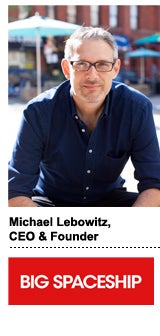
“You hear people say both things, but neither one is true,” said Michael Lebowitz, CEO and founder of Brooklyn-based digital agency Big Spaceship, whose client list is a who’s who of blue chip brands, including Nestlé Purina, Samsung, BMW, YouTube, Absolut Vodka, ABC, Coca-Cola, Food Network, Victoria’s Secret, Nick, Jr., Fox, Target and Skittles, among others.
The creativity vs. data debate was hot at Cannes this year, with The Wall Street Journal’s Jack Marshall noting that he heard complaints that “ad tech is taking over the festival and that the creativity the event is supposed to celebrate is being drowned out by talk of algorithms and automation and data.”
The focus in ad tech is actually starting to move away from centering solely on the pipes, said Rob Griffin, EVP of media futures and innovation at Havas Media Group.
“Up until now, the focus has been too heavily weighted to the purchasing of programmatic media and letting the algorithm do the work,” Griffin said. “The next level is to drive programmatic creative and push for dynamic personalization at scale. The technology can help here, but this will require more human intelligence, insight, strategy, creativity.”
The word “versus” isn’t particularly productive either, said Lebowitz, whose appointment as jury chair of the 11th annual IAB MIXX Awards was announced Tuesday.
“With the right system in place, data and creativity make each other better,” he said.

Lebowitz defines “the right system” as one in which services aren’t tacked on like awkward lean-tos.
“Agencies often silo themselves in terms of service offerings, especially around digital,” he said. “They bolt a digital practice or a social media practice onto their existing offerings, but they haven’t made, nor is it easy to make, structural changes that put digital at the center.”
Big Spaceship itself operates in interdisciplinary teams rather than departments. There’s no creative department and there’s no production department. Each team, including the data and analytics group, is comprised of designers, technologists, producers and strategists. No one’s a creative, per se, but everyone is expected to create. [The Harvard Business review wrote a 37-page case study about Big Spaceship’s unique project-based structure in 2009.]
“Our philosophy around data is that it’s not just a way to validate targeting or prove a hypothesis after the fact – data itself is creative,” Lebowitz said. “Businesses need to change if they’re going to embrace how innovation actually happens and how customers actually experience the world.”
The pendulum has shifted away from the idea of “highly specialized agencies,” said Noah Mallin, head of social, North America, at MEC, where the agency adopts an integrated mindset.
“We have social teams that work in a highly integrated way across all of the digital things we do and we’re encouraged to think about everything from out of home to television to display using a social lens,” Mallin said. “It’s a lot harder to do all of that when you’re working in a really specialized social agency, where we probably wouldn’t have access to the data or the programs that my colleagues have access to.”
There’s no particular template in place anymore, Lebowitz said. YouTube videos can become television spots. TV spots can be part of a brand’s social media strategy. It just requires a certain amount of nimbleness.
 The rapping corgi is a good example. In 2014, content strategy agency Reach Entertainment worked with web-based comedy troupe Jash to create a series of videos to promote Nestlé Purina’s Beggin’ product, which comes in a special packaging that shoots snacks up in the air for dogs to catch. Big Spaceship took care of the digital activation.
One video in particular, which starred a stylin’ corgi in shades rapping about his love of bacon treats, got good organic traction on its own, prompting Purina to cut it down into a 30-second spot the brand aired during the 2015 Grammys. Big Spaceship ran a social war room at the show while Mindshare handled the media.
“There’s no one truth anymore, and with a forward-thinking approach you can change the distribution mix and the order of that distribution,” Lebowitz said. “Instagram videos can become TV spots, static Pinterest posts can become print ads. Digital is flipping the model inside out.”
And that’s why, in Lebowitz’s view, the agency/client relationship is ascending, not on the way out.
What’s changing is the way in which agencies collaborate with advertisers. Rather than “going away and then coming back with a shiny object or a tagline for the client to make comment on, we workshop with clients. It’s the tension between our role and their role that leads to good work, the most effective work,” Lebowitz said.
But are clients turning their back on the concept of AOR?
“There’s been a lot of discussion about the death of the agency of record, but while certain clients might have the culture and the resources to do it all themselves, many others don’t,” Lebowitz said. “The pronouncements you hear about the death of the agency/client relationship seem silly to me.”
However, it’s also the ad tech players themselves that in many cases need agencies to achieve success, noted Marco Bertozzi, president of global clients at VivaKi, in a recent column for Campaign US. “Each new company that arrives on the scene seems to come with fewer and fewer people to help service clients. And who do they turn to in order to fill that void? Agencies.”
As for algorithms and automation, they’re far from mutually exclusive from the creative impulse, Mallin said.
“Data can fuel creativity and that’s really how it should work. We don’t want to put limits on creative thinking and how we can bring stories to live in creative ways, but we also want to do it in a way that’s based in reality,” he said. “Data gives us that reality and sets the canvas that allows us to be creative.”