 It’s a question every CMO must answer: How much of my first-party data can safely be shared with tech platform partners?
For advertisers in categories where Google has a product offering of its own, the question has even more urgency.
Consider ADT, whose home security business faces an emerging competitor in Google’s Nest smart thermostat and home automation product line.
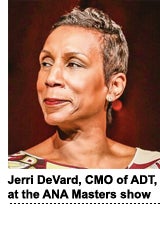
“For me, Google is in spaces that compete with me, so even though there are always supposed to be walls up against sharing data, I’m always just a little nervous about that,” Jerri DeVard, CMO at ADT Corp., said Friday during a panel discussion at the Association of National Advertisers’ Masters of Marketing conference.
“In the back of my mind, it’s always ‘Is this information going to come back and haunt me or hurt me?’” DeVard said.
The panel discussion also included McDonald’s CMO Deborah Wahl, Dunkin’ Brands global marketing president John Costello and Starcom CEO Lisa Donohue. Suzanne Vranica, advertising editor for The Wall Street Journal, moderated the panel.

For McDonald’s, the concern around freely sharing data with platform companies has less to do with competitive concerns than self-determination.
“When you have those requests from Facebook and Google to have all the data, that would be giving away our decision-making capabilities,” said CMO Wahl. “That’s where companies like ours have to get really creative.”
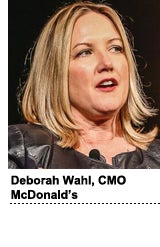 Rather than fork over raw data files with sensitive business and campaign information, the company has experimented with sharing high-value segments that are of a slightly more generic nature. “We did a test with Apple and got high performance out of it,” she said. “Everyone’s trying to find their way.”
Dunkin’ Brands’ Costello is a data-savvy marketer by any measure. Under his leadership, the company made a commitment more than six years ago to beef up its first- and third-party data collection.
“Every morning at 5:30, I get sales by item by hour from the previous day,” he said. “We also get third-party data on guest experience and brand perception.”
Lately, the company has bolstered its first-party data asset with insights gleaned from its mobile app. “That’s enabled us to serve up more relevant messaging and offers to the consumers, but also to more precisely measure the ROI of that.”
Costello said the perceived dangers of sharing data with vendors – product data, pricing data, customer lists and so on – must be weighed on a case-by-case basis, according to the benefits and risks inherent in each partnership.
“You don’t want somebody to have your proprietary product development data,” he said. “On the other hand, if you want to benchmark market share it’s impossible to do that without sharing data. It boils down to: What’s your objective and what’s the risk of sharing that data?”
These concerns have led to a more rigorous approach to contracts, at Dunkin’ and elsewhere.
“Early in my career, the data paragraph was the one you delegated to a marketing assistant,” Costello said. “Now you’re poring over every verb.”
Many marketers are not as thoughtful, according to Starcom CEO Donohue. “I’ve watched people turn over reams of data, including cost data, to Google because it’s Google.”
Donahoe added that one difficult aspect of working with big companies, such as Facebook and Google, is that the data often doesn’t flow both ways.
“When doing multitouch attribution … you have to have the data across your whole system to be able to do the modeling work,” she said. “Increasingly you are seeing walled gardens. If there’s vertical optimization within a media partner, fine, but if you can’t look horizontally,” it’s hard to see what works.
 When To Ignore The Data
As a counterpoint to the data protection alarmism, the same group of panelists stipulated there is often an overreliance on data in marketing circles.
“I say data is overrated,” DeVard said. “I sit in meetings all the time where people present data and I sit back and say, ‘So what?’ It’s not the data, it’s the insights.”
As an example, she said ADT’s messaging has recently shifted toward a story around home automation. The company’s performance data from direct marketing television and other channels shows these ads don’t resonate as well as the company’s security-themed ads. However, that’s beside the point because the company is positioning itself for a future where it serves the holistic home automation needs of its customers, including thermostat, connected appliances and other functions.
Dunkin’ Brands’ Costello describes the condition of over-measurement as “analysis paralysis.”
“Big data is not a strategy, it’s a tool,” he said. From a product development standpoint, Dunkin’ relies as much on its culinary experts as it does on third-party data and external market research.
“If they see a trend coming, you may need to trust the experts in the field. If you become too data-driven you spend all your time looking at the rear-view mirror as opposed to looking through the windshield,” he said. “It’s important to be very analytical, but don’t downplay your judgment if you see trends emerging or if consumers are having difficulty explaining what they want.”
Costello’s comment was echoed by another speaker at the conference, GE chief marketing officer Linda Boff, who said it’s sometimes important to allocate dollars on a wing and a prayer.
“We’re proud of the fact that we sometimes drive mindshare before we drive market share,” Boff said. “Are we chasing the shiny object? Maybe a little bit. You only get one chance to be in front, the moment passes quickly and platforms get saturated.
“Spoils go to the early mover.”