

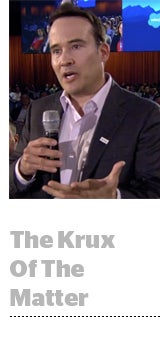
 The Marketing Cloud keynote address at Dreamforce included a phrase never before uttered publicly by a Salesforce exec: “You can’t be a marketing cloud without a DMP.”
That was SVP and chief product officer Bryan Wade, speaking to around 3,200 Marketing Cloud partners and clients about Salesforce’s intent to acquire Krux.
“Think of us as the brain for the marketing cloud,” Krux CEO Tom Chavez told the crowd, by way of introduction.
The marriage caps off a long partnership between the two companies, in which Krux was Salesforce’s preferred DMP. “We’d even co-sell with them in the field,” Marketing Cloud SVP Eric Stahl told AdExchanger.
While it’s still unclear why it took Salesforce so long to buy what it now acknowledges is a core marketing suite component (VP of ad products Liam Doyle said Salesforce doesn’t acquire products just because other competitors have them too), Krux’s value is apparent to execs like Erwin Hinteregger, CMO of shoe and accessory retailer ALDO Group. ALDO doesn’t currently use a DMP and had been briefed by Salesforce about the Krux acquisition.
“The DMP allows me to put in my database every single contact, in whatever digital platform, around the same, single consumer ID – it doesn’t matter if it’s a banner ad click, an email, or any type of communication – and I can pull the data, which I own,” Hinteregger said. “DoubleClick doesn’t give you a lot of data. If I have the DMP and my media agency deploys a campaign, I know every response from the consumer and it goes back to the database.”

Krux’s origin as a publisher-focused DMP could also be a boon. First generation DMPs were split between publishers and marketers. Publisher DMPs collected and helped monetize first-party data. Marketer DMPs tended to focus on third-party data for targeting and campaign management.
But Salesforce’s power across all of its clouds – including marketing – is its ability to execute campaigns based on first-party data, which makes Krux an ideal DMP.
In 2015, Krux also began straddling the line between publishers and marketers, hiring a Kellogg Co. exec to build up its marketer client base.
“Krux had it right by recognizing early the intersection between publisher and marketer and being the link between the two so their data sets could act as one,” said Chip Schenck, VP of data and programmatic at Meredith Corporation.
Increasingly, marketers are building content departments – essentially becoming publishers themselves. ALDO, for instance, created an in-house studio about 15 months ago. “It took six months to figure it out, and the last six to nine months, we’ve been producing really good content,” Hinteregger said.
There’s value even for advertisers with no desire to get into the publishing business. As Schenck points out, publishers and marketers often use the same technologies for different ends. For instance, a tool that provides targeting for advertisers can also provide reporting for publishers.
Consequently, if marketers couldn’t get a DMP from Salesforce, they would very likely get it from one of its competitors. So did Salesforce risk losing customers if it didn’t acquire a DMP?
Stahl paused before answering carefully: “There’s no question that the DMP has become a strategic piece of infrastructure for a lot of the biggest brands out there,” he said. “That is what drives our acquisition strategy. When a customer designates a category as a core strategic asset, that’s when we’ll start looking more at it.”
Mark Lush, principal at Deloitte Digital, is more blunt. “They absolutely did,” he said. “More to Adobe than Oracle.”
Many customers deploy Oracle Marketing Cloud because of a legacy relationship with Oracle’s Enterprise Resource Planning software, Lush said. Customers who don’t have an entrenched relationship with Oracle are – grossly generalizing – more likely to go with Salesforce Marketing Cloud.
“We’re not seeing a ton of huge nasty head-to-head competitions between Oracle and Salesforce Marketing Cloud,” Lush said. “Salesforce tends to win. But Oracle will make strides in the next year. They’ll get noticed, and you’ll see much more head-to-head competition.”
Currently, some clients question whether the Oracle Marketing Cloud tools do everything marketers need, Lush said, so they’re perfectly willing to buy the Oracle DMP (formerly BlueKai), but use the Salesforce Marketing Cloud.
Adobe, which has the Audience Manager DMP, is different.
“With Adobe being a mature marketing suite, it was easier for a client to say ‘I get everything I want out of Adobe,’” Lush said.
Notably, Salesforce and Adobe Marketing Clouds have very different capabilities. “There’s a 30% overlap in functionality,” Lush said. Adobe is more focused on content, while Salesforce is focused on marketing executions and operations.
Salesforce’s Stahl agrees on this point, adding that Adobe’s strength is in creative, web infrastructure and web analytics.
“We don’t compete in those spaces – any of them,” he said. “We compete around sales, service and marketing. … Adobe doesn’t have sales, service, community, BI analytics and they don’t have an IoT cloud.”
But with Krux’s legacy as a publisher DMP, Salesforce could slowly start encroaching on Adobe’s content turf.
The trick now is getting marketers to buy in. Because while a DMP might be a big strategic asset with numerous benefits, deploying one isn’t a snap decision.
“We just had a meeting on it!” said Jennifer Oleksiw, VP and Information Officer at global pharmaceutical firm Eli Lilly and Company. “Right now, we don’t use a DMP. Right now, we’re just starting conversations on what these new acquisitions are all about. So, more to come.”
ALDO’s Hinteregger said there are costs to consider when implementing a DMP – and it’s important to make sure a marketer has the staff to manage it, either in-house or at the media agency. (ALDO uses iProspect)
“It’s a big decision, and we don’t want to screw it up,” he said. “It affects your business immediately if it doesn’t work.”
And, of course, Salesforce still needs to close the deal and integrate the Krux software.
“When I joined ALDO and decided to get ExactTarget, that was exactly when Salesforce bought it, so we went through a little bit of pain – but that’s natural, Hinteregger said. “Whenever the big guy buys the smaller guy, they have to go through the integration, and it doesn’t always go as anticipated. It will take them a little while, but it’s a very smart move, and I look forward to it, because Krux is one of the good ones.”








