
 A survey of marketers found deterministic data is used more often and is more effective at driving revenue than probabilistic methods. But the line between the two has become blurred as more companies turn to a combined approach.
The findings come from a “State of Identity Management” report from market research firm The Relevancy Group (TRG). The company surveyed 301 advertising and marketing executives across the financial services, media/publishing, retail and travel/hospitality industries.
TRG found that 32% of marketers plan to use deterministic targeting, 30% plan to use a combination method and 19% plan to use probabilistic targeting in 2016.
Although deterministic was the most preferred method, Peggy Reinders, a TRG principal analyst and co-author of the report, said she is uncertain how marketers will carry out their plans given that the walled gardens of Facebook and Google represent the two most scalable deterministic options.


Marketers might look to portals outside of Facebook and Google for deterministic data, such as cross-device co-ops like one Adobe recently rolled out, but Reinders said she suspects marketers targeting exclusively on a deterministic basis may just increase their spends with Facebook and Google.
Executives also were asked which method has been the most effective in driving revenue. Thirty-two percent said deterministic targeting is most effective, 27% said a combination method is most effective and 22% said probabilistic targeting is most effective. One out of five respondents reported they don’t know which method was the most effective revenue driver.
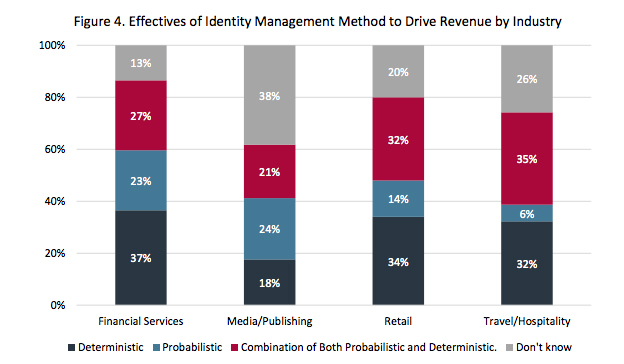
Financial services had the greatest predilection for deterministic matching, with 37% citing it as the most effective revenue driver. Meanwhile, media/publishing respondents were less certain. Fully 38% of media industry respondents said they don’t know which method is most effective at driving revenue, while 24% said probabilistic and 18% said deterministic.
In the travel/hospitality industry, 35% reported that a blended approach was the most effective revenue driver.
Because deterministic matching involves using known user data (such as an email address) to make a match, it’s been alleged to be more accurate than probabilistic matching, which infers user identity based off anonymized data signals (such as IP address, device type and browser type). According to the report, deterministic’s accuracy drives revenue by facilitating “more relevant messages that are known to have higher engagement rates.”
But because scale can be a problem with deterministic data, blended approaches will likely become more common in coming years, Reinders said.
“If you want to use more ways of advertising outside of Facebook and Google in order to get that scale and to be able to market to people in a mobile environment,” she said, “you need a combination of both methods.”








