 Marketron wants to help the 6,500 or so broadcast radio stations that use its revenue management software to transact spot radio in a programmatic fashion.
The company has rolled out an offering, dubbed Mediascape, allowing stations to see their sell rates and inventory avails, and then select those avails and publish them to Marketron’s cloud-based supply-side platform.
This being radio, Marketron’s definition of “programmatic” is not real-time and neither can it support impression-level targeting of the sort digital buyers are used to. Programmatic here means automation, allowing stations to easily expose inventory and overlay it with audience and inventory data for regional and national buyers.
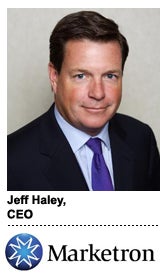
According to Marketron CEO Jeff Haley, “The spots are going to have a combination of first-party and third-party data that are inputted on the supply side from the broadcasters and also on the buy side from marketers and their agencies.”
But, he added, “This isn’t a two-way medium. The ability to leverage the success of that data is going to take time to figure out because we’re a call-to-action, retail-driven medium.”
Terrestrial advertisers have data around ad placement, delivery time and the levels of premium inventory available, in addition to Nielsen data.
Haley said no clients are transacting on the platform yet, but claimed 20% of the $15 billion spot radio industry could be traded programmatically in the next 12 to 18 months. About 6,500 of the 10,000 commercial radio stations in the US use Marketron’s software for revenue management and audience engagement solutions, Haley told AdExchanger.

“Unique to radio is the sheer size and number of outlets,” he added. “The medium reaches about 280 million Americans weekly, but it does so across 10,000 outlets. The diversity of outlets gives us the ability to deploy programmatic on both a spot basis for national advertisers and also drive the efficiency of the transaction for local broadcasters.”
Marketron works with clients like Univision and Cox, in addition to smaller, independent broadcasters.
In a live demo at the Radio Ink Conference in San Jose, Calif., on Wednesday, Marketron executed two programmatic transactions showing the tool at work. The first showcased a buy for Marketron client Hubbard Broadcasting, in which a Hubbard-owned station sold 20 spots per week to Aloft Hotels. The second was for a local radio station in Idaho, SKI-FM Sun Valley, which sold inventory programmatically to local insurance provider Wood River Insurance.
According to Haley, broadcasters are sitting on a large amount of audience data that comes in through their digital streaming activities. Those audiences engage by opting in for texting, buying tickets online or interacting with radio stations on social media. There exists an opportunity to project data from those digital interactions across into the broadcast environment, even if the targeting is still in aggregate.
For now, Haley hopes Marketron’s development will boost the efficiency of terrestrial radio advertising and increase ad spend in the industry.
“The consequences of this is that national advertisers now have an efficient means to buy very deep into markets,” said Haley. “Instead of making a top-20 buy, they can make a top-100 market buy.”
“The net effect will be more dollars flowing into [terrestrial] radio, as opposed to splitting the existing dollars, simply because it gets easier to buy,” he added.
Marketron’s offering is not the first attempt to bring programmatic sales to the radio channel. In April, iHeartMedia debuted a real-time programmatic offering for broadcast radio, powered by Jelli’s cloud-based ad platform. When it surfaced, ZenithOptimedia, Universal McCann and Horizon Media were the only agencies to trial the solution, and iHeartMedia COO Brian Kaminsky told AdExchanger it would take four or five months to roll Jelli’s hardware and software into its radio stations.