
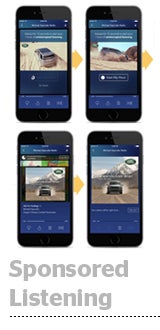
 Pandora took its Sponsored Listening product out of beta on Monday.
The mobile ad format lets brands sponsor an hour of uninterrupted listening for Pandora users in exchange for 15 seconds of engagement with an ad.
“Advertisers are hungry for a model that lets them buy attention and we’ve seen really great interest from the market,” said Jonathan Eccles, the product manager at Pandora who led development on Sponsored Listening.
During the 12-month beta period, advertisers like Land Rover North America tested the offering. New brands leveraging Sponsored Listening post-beta include Corona Extra, Gatorade, truTV and Yuengling.
“Given the often-cluttered advertising environment, Sponsored Listening is an ideal alternative to reach our customer base more organically,” said Kim Kyaw, digital marketing and social media manager at Land Rover North America. “Not only does it allow us to capture listeners’ time and attention, Sponsored Listening also allows us to differentiate from the competition by providing Pandora listeners with a branded, yet uninterrupted, listening experience.”
Once users opt in to Sponsored Listening, they’re presented with a 15-second video ad, after which they can begin playing music or continue watching the ad, which can support videos up to two and a half minutes long. Advertisers can also opt for swipeable slideshows or 360-degree product views in the place of ads.

“What really surprised us when we started this product in beta is that people were continually tweeting about it,” Eccles said. “We actually are seeing people listen more to Pandora and become more loyal.”
Pandora claimed beta testing of the format led to a 12% lift in brand awareness and a 30% lift in purchase intent. Advertisers leveraging the format get a variety of reporting metrics, including how much of the video a consumer watched and how many times they interacted with branded ads.
The offering builds on Pandora’s Brand Station Platform, that lets advertisers customized a branded listening experience for audiences with display, audio and video messaging.
According to Eccles, the format was built in part to offer a buying model that enables advertisers to buy attention directly.
This is the first time Pandora has leveraged a cost-per-engagement pricing model based on time spent. In other words, advertisers only pay for the format if consumers choose to interact with an ad.
Pandora declined to share specifics about the price of the format.