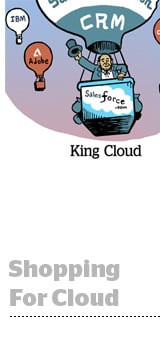
 Salesforce dropped $2.8 billion on ecommerce platform Demandware on Wednesday, which will underpin the creation of Salesforce’s latest business line: Commerce Cloud.
The deal catapults Salesforce into the ecommerce space – a tech category largely dominated by enterprise competitors like SAP/hybris and IBM/WebSphere, though Salesforce first dabbled in ecommerce in 2012, when it acquired site personalization and ecommerce recommendations tool iGoDigital.
Demandware brings hundreds of brand clients to Salesforce – like Marks & Spencer, Crocs and Lands’ End, which use Demandware to run ecommerce businesses across their desktop sites and mobile apps.
Integrating the Salesforce Commerce and Marketing Cloud (whose clients include L’Oréal, Unilever and Luxottica) seems like a logical progression of this deal.
“Marketing and commerce are merging,” said Jason Goldberg, SVP of the commerce and content practice at Razorfish. “Any big retailer’s home page is the front door to their highest-volume store. Beyond buying goods, a brand’s website is often the first place you go to learn about Tory Burch or Michael Kors. Everyone needs web properties to wear both hats.”
Merging commerce and marketing solves disjointed retail processes. For instance, consumers don’t want to be retargeted for a product they already bought.
Goldberg noted, however, a couple of areas where Salesforce and Demandware aren’t in perfect alignment. Demandware operates on a rev-share model, whereas Salesforce sells software subscriptions or charges flat fees.
And Salesforce serves a large B2B customer base, while Demandware mainly plays in B2C.

“If each of the platforms add features that appeal to the other’s market, it creates significant new growth opportunities,” Goldberg said. “Salesforce could add more retail-centric features to the rest of their stack and be more successful in the [B2C retail] space by leveraging Demandware.”
Ecommerce remains an attractive acquisition area for deep-pocketed enterprises. Adobe made a bid for Demandware, according to AdExchanger sources, after SAP edged out its bid for hybris in 2013.
“We see marketers spending more on digital commerce, now 11% of the marketing budget,” according to Jennifer Polk, a research director at Gartner. “Sixty-four percent rank digital commerce as a leading area of mar-tech investment.”
While IBM, SAP and Oracle are commerce heavyweights, all are expanding their marketing businesses. Conversely, digital experience providers like Sitecore and Adobe are trying to enhance their commerce capabilities.
Thus, the marketing cloud is becoming less and less of a standalone function in the process, said Rebecca Lieb, former Altimeter Group analyst and principal at consultancy Conglomotron.
“Clients need integration with commerce, sales, finance, all types of enterprise applications,” she added. “It’s the only way marketing can effectively do its job. It’s not an island, it’s a component of a greater whole.”
Salesforce did not comment publicly beyond an investor and analyst call it hosted Wednesday morning, when Alex Dayon, president and chief product officer, said Demandware would give Salesforce more in the way of “one-to-one commerce experiences” and would bridge the gap between the digital-physical store.
“Having more [data] signals from a digital commerce platform makes our offerings much stronger,” he said. “It was a very strategic acquisition for us. [We will have more] intelligence for sales, service, email marketing.”
The Demandware deal is expected to close by the end of the second quarter in July; Salesforce is projecting $100 million to $125 million in FY2017 revenue accretive to the acquisition.
Updated with comment from Gartner.