

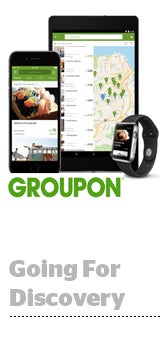
 Groupon is trying to evolve from an aggregator of merchant discounts to a destination designed for “local discovery.”
Rather than asking consumers to redeem a discount via a single daily email, Groupon wants to weave its service more broadly into the fiber of local commerce – whether that’s facilitating merchant payments or surfacing active deals for relevant merchants when a consumer searches on partner portals like YP.com or the YP mobile app.
To help it get there, the company has ramped up paid media spend, including a recent prime-time television spot that was the first national TV advertising the company has run since 2011.
These efforts are meant to increase the flow of demand to its deals database, which hosts 700,000 active global deals in categories like local (restaurants and a lot of spas), travel (local tours and getaways) and shopping.
“The most tangible change [in our business] has been deal density,” according to Jon Wild, VP of North America marketing for Groupon. “Groupon launched at the end of 2008 as a daily deal email company offering one deal per day in each of our local markets. At the time of our IPO in 2011, we had less than 1,000 active global deals.”
But the company has a lot of ground to make up. Competitors like Foursquare are also angling to reinvent search and discovery through spinoffs like Swarm while payment services with serious startup appeal like Square are ramping up their merchant marketing offerings.
Groupon executives spent $39 million on acquisition marketing tactics in the first quarter, which yielded 1 million net new members to reach a total of 50 million active users, its highest quarterly increase in two years.

That’s down significantly from the 150 million monthly active users Groupon reported in 2014. (Edit: Groupon had 150 million monthly users in 2014, per a shareholder document, but that figure was based on email subscribers a figure Groupon says it no longer reports out. Now Groupon tallies “active customers,” which is defined as someone who has made a Groupon purchase in the last 12 months. At the end of Q1 2015, it was 24.6 million in North America. At the end of Q1 2016 (the most recent quarter), it was 26.9 million).
Groupon mainly spent on performance channels, such as email, affiliate, display, mobile and paid search. It’s now expanding into offline channels such as TV, radio and print to move away from what CEO Rich Williams terms “transactional tactics,” low-margin drivers of quick product redemptions, as opposed to broader awareness and retention-building campaigns.
Williams projected last year that Groupon would spend a total of $150 million to $200 million this year on marketing, inclusive of the $39 million invested last quarter.
One historic complaint with Groupon was that merchants often felt conflicted about the value of the service. Although the service brought in new foot traffic to participating merchants, it was difficult retaining those customers beyond the one-time redemption.
“We don’t hear this much anymore, but it still comes up on occasion,” according to Jon Wild, VP of North America marketing for Groupon. “During the last quarter, 81% of Groupon customers said they were likely to return to the merchant.”
Merchants commonly struggled to make a margin on the deals they did offer through Groupon, at times taking a loss on those deals.
Wild noted the vast majority of deals today (82% as of the last report) are break-even and required no cross-selling efforts on the part of the merchant.
That said, Groupon recognizes deep discounts aren’t for every brand, so the company is exploring more market-rate offerings for merchants.
Comcast’s independent private investment firm, Atairos, invested $250 million in Groupon this April.
“Comcast is a great company with lots of assets … and we are exploring lots of ideas,” Wild said. “We’ve already seen promising early returns from our increased marketing investment and customer acquisition programs. As our marketing spend has ramped, so have active customers.”







