

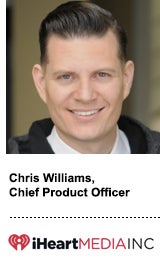
 IHeartMedia relies heavily on listeners to inform its online marketing efforts.
When advertising its stations, the digital audio giant has found its biggest influencers aren’t celebs with millions of followers, but music fans who write quality social media posts, said Chris Williams, iHeartMedia’s chief product officer.
“If you can find the five or six Justin Bieber fans who follow his every move, tell other fans what’s going on and have built up their own authority,” he said, “their posts are typically far more engaging than what you would get from the celeb himself.”
IHeart analyzes anonymized and aggregated data across platforms and flags relevant conversations using a social listening tool called Sysomos. Sysomos recently gained insights from Facebook topic data with Scout, a dashboard that hooks into Facebook topic data partner DataSift.
While social listening is not new, iHeart uses the resulting data sets to discover and build segments off of new audiences that wouldn’t otherwise be on its radar.
“We’re pretty good at being able to say people who like country music look like this, dress like this, shop in these places and drive these cars,” Williams said. “What Scout allows us to do is use a conversation that’s taking place out in the real world and find out who that person is, what affinities they have and where they live.”
Even though Facebook’s data is anonymous, the aggregate information shows strong conversational spikes that are valuable for targeting, said Phil Burch, product marketing manager at Sysomos.
After finding these fans, iHeart engages with them beyond standard goals such as likes, tags and reposts.

For example, the audio company will invite its most socially active Florence and the Machine fans to the band’s intimate, 100-person concert at the iHeartRadio Theater in New York City, as opposed to a group of random people who happened to win a raffle.
“You can capture some really cool content by seeding the audience with people who find tremendous value in the experience,” Williams said. “They share that passion with their following in a way that’s really organic. We’re brought into that conversation in a much more meaningful way, and there’s a greater chance of our voice being discovered.”
By letting fans share the lineup at this year’s iHeartRadio awards, the digital audio company saw 115 billion social impressions around the event in 2016 – up from 14 billion impressions in 2015, Williams said. Post sentiment, which Sysomos can measure by analyzing keywords and reactions, was 93% positive, #iHeartAwards was a trending hashtag in 50 US cities and the awards show brought in 60 million votes.
These results helped iHeartRadio strengthen its narrative as a brand that can connect fans with their favorite artists in meaningful ways.
As a digital audio publisher, iHeartRadio is getting deeper into data-driven targeting. This month it launched a programmatic marketplace in the US, which dynamically stitches ads into digital streams based on user profiles.
“You might very well be listening to the exact same radio station at the exact same time as me,” Williams said, “and the ads that are being delivered to you are going to be very customized to who you are and where you are at the moment.”








