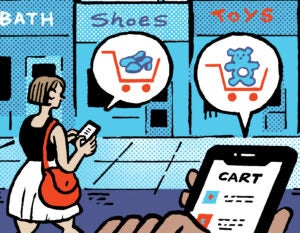
Emodo, Ericsson’s mobile ad platform for telcos, is aiming to boost the quality of location data in the ad ecosystem with a tool launched Thursday that uses carrier data to verify mobile audiences on a pre-bid basis.
Marketers are shelling out for bad targeting and it’s akin to flushing their budgets down the toilet, said Paul Cheng, GM at Ericsson Emodo, which helps carriers aggregate and monetize their subscriber data.
“People spend a lot of time talking about viewability and brand safety, but the data accuracy problem is more prevalent than most people realize,” Cheng said.
Around 59% of exchange-derived location data is junk, according to Placecast, a location ad tech company Emodo acquired in February.
A lot of the problem is related to how location data is derived.
“Location data is collected from two sources: the device itself from the sensor or GPS and from the cellular network,” Cheng said. “Carrier data from cell towers is 100% accurate, but not necessarily precise, and GPS data is very precise, but not necessarily accurate. It’s a balancing act between the two.”
Precision refers to the range of possible error and accuracy is how close you are to hitting your mark, so it’s possible to be precise and highly inaccurate.

“For example, an SDK in an app can pull GPS and a six-digit precise lat/long,” Cheng said. “In reality, though, the device might be a hundred miles away from the known location, because we don’t know the last time the lat/long was updated.”
But carriers must have accurate location data to provide subscribers with reliable cell service – which is why their data makes a solid truth set to verify mobile audiences and inventory.
Applying technology that came along with its Placecast acquisition, Emodo uses carrier data to train a machine learning model to score the validity of other data sets. If a model’s smart enough, probabilistic matching can be just as accurate as what you get from a deterministic match, Cheng said.
“It’s a combination of proprietary whitelists and blacklists filtered by domain and source compared with machine learning models,” he said. “It’s a fairly large data science problem.”

Marketers can activate the verified data in their demand-side platform of choice, although they have to do it using a deal ID. Emodo doesn’t sell data outright and marketers never get access to actual advertising identifiers.
Emodo’s audience verification product isn’t a value-added service. Existing buy-side clients must pay for access, but the ROI backs out, Cheng said.
“When you compare apples to apples, the return is there,” he said. “It ends up being a better deal than wasting half of your ad spend and bidding on impressions that aren’t even close to your targeting parameters.”
Which all sounds well and good, but what about the four-letter word, GDPR? Europe’s newly implemented privacy regulation is top-of-mind at Ericsson, Cheng said.
Carriers have always operated in a highly regulated industry, which means they didn’t need GDPR to tell them to get consent. Only consented data makes it into Emodo’s models, which is anonymized, aggregated into segments and then only used to measure the quality of other data sets and not for any direct targeting.
“We do a lot of what we call data wrangling, which means that we pre-process data to normalize, harmonize and anonymize it,” Cheng said. “The only data that leaves the carrier is associated with an advertising ID and it’s not reversible in that it can’t be linked back to a specific person.”