

 The mobile web is way too slow for publishers and users alike.
Google, along with platform and publisher partners including Twitter, Vox, BuzzFeed, the Guardian and The Washington Post, unveiled its answer to this problem on Wednesday: the Accelerated Mobile Pages (AMP) project.
“Anything less than instant shows a decline in engagement,” said Richard Gingras, head of news for Google.
The AMP technology pre-caches and pre-renders publisher web pages so they load in a wink. That also means they use less data. In tests, pages loaded 85% faster than without the technology.
The biggest kink will be getting advertising to load as fast as the content. That’s the goal, but ads load slower than content, both Google and publishers demoing the project confirmed.
Speeding content load times will help with publisher monetization, especially as many publishers are now seeing mobile web traffic overtake desktop traffic. The Washington Post, for one, said its audience is 60% mobile, roughly average for most publishers.
“The mobile web is where we have scale,” said Cory Haik, executive director of emerging news products for the Post. “That’s where we have audiences, and they’re just as important as our mobile apps.”
Because apps are designed for mobile, content loads quickly. But many users read content on the mobile web, where publishers are hampered by technology designed for desktop browsers, not mobile ones, Gingras explained.
AMP also improves the Google search experience, perhaps one reason Google is leading this open-source project. Search for “Taylor Swift” or “Syria” and a carousel pops up with pictures and snippets of the article, making it quick to scroll through top stories.
But Google said it would not introduce a paid amplification to this carousel of results, keeping the search results purely organic.

Publishers will also be able to use AMP links to make content on other platforms faster. That includes Twitter, a key partner for the AMP project, but also Facebook. Instead of Facebook Instant Articles, publishers could simply use an AMP-compliant link to make content load quickly.
Google is describing the project as a “technical preview,” not live, which means that there are still kinks to work out.
Yet while Google appears to have made strides in speeding mobile content speeds, ad loads are a different story.
Getting ads to load as quickly as content will require creating technical specs for ad partners to use. On the content side, Google showed how a long paragraph of JavaScript was turned into a single line. The same would happen on the ad side.
There also may be limitations around what kinds of ads can work in AMP.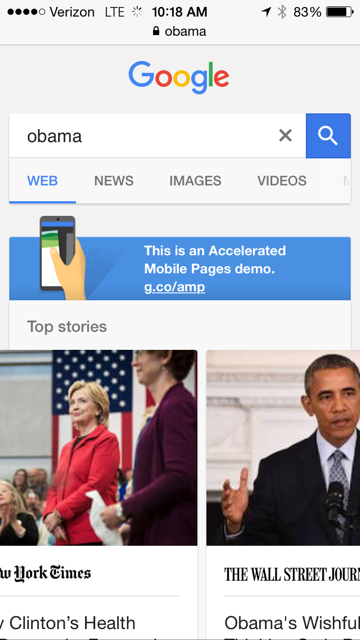
“We recognize that there are bad ads on the web, but ads are an important part of the ecosystem,” said David Besbris, Google VP of engineering for search. “Some of the limitations we’ve built into the framework make sure [ads] don’t detract” from the experience.
What AMP will actually limit is still unknown, in part because it’s a work in progress and those decisions haven’t been made yet.
While AMP may limit some of the more intrusive ad formats, it also may provide the opportunity for publishers to create new ones. “Our hope is that we can create a new ad experience with this format,” Haik told AdExchanger.







