

 Macy’s is getting experimental with location data.
“Location data can help us move from cross-device to omnichannel,” said Kimberly Yarnell, VP of digital media at Macy’s, speaking at the Mobile Marketing Association’s mobile location leadership forum on Thursday in New York City. “I like to think about location as being the key to providing context for a meaningful interaction with the consumer.”
For one, the where can have a palpable impact on the what. The message Macy’s would send to a woman searching for a dress on her PC at home is, or at least should be, different from what Macy’s would serve up to the same woman conducting a search on her phone when she’s near a store location.
“But location is not just about where a person is at a moment in time, it’s about where he or she has been and understanding where he or she may go,” Yarnell said. “That’s an incredibly important useful line of sight for marketers to have as we’re building out a sequenced marketing campaign.”
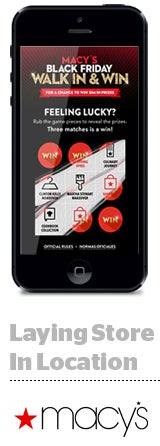
Macy’s put that concept into practice with a campaign designed to drive more foot traffic during Black Friday weekend.
Shoppers with the Macy’s app who walked into a store during the designated time period would receive a beacon-triggered push notification to play mobile scratch-card games for a chance to win cash, prizes and discounts. In the two months leading up to the campaign, Macy’s outfitted its roughly 800 store locations across the US with beacons from smart-tech provider Zebra.
The campaign put a particular focus on its Herald Square location in Manhattan on Thanksgiving Day, when more than 3 million people gathered nearby to watch the Macy’s Thanksgiving Day Parade – a semi-captive audience in good spirits.

Macy’s used xAd to place a geofence along the parade route and around the store, and served location-based ads encouraging people to come in and play.
The proximity targeting drove the most reach while the on-premises beacon targeting drove the highest engagement – both logical conclusions. Macy’s used xAd to tie incremental store visits to the campaign, although Yarnell declined to share specific results.
It’s a cool idea on paper, but Yarnell readily admitted the user experience was a little clunky. Not only did players have to first download the Macy’s app and fill out a form to register, they had to enable location services, opt in for push notifications, turn on Bluetooth and actually visit a store before they could participate.
“We learned that simplicity is key,” Yarnell said.
The Herald Square activation was also a one-off, or at least it’s something Macy’s could only do as frequently as once a year when Thanksgiving rolls around. Macy’s is actively considering how to create an always-on location strategy.
“We did drive incremental foot traffic and it did drive sales, but it was a moment in time and there were challenges around scale,” Yarnell said. “The tools are there and the plumbing is there – but we need to figure out how to connect all the dots.”
It’s from an easy feat considering how fragmented the landscape is. That’s why when Macy’s looks for marketing partners, it’s not looking at the LUMAscape.
“[That] does not help me as a marketer when I’m trying to evaluate the space,” she said.
Macy’s wants to light upon the tech solutions “that can support deterministic cross-device identity” and extend “that effort ultimately into an omnichannel-focused strategy,” Yarnell said.
To that end, Macy’s has found value with a pared down list of partners, including Facebook, Twitter, MoPub, Hearst, AOL, Adelphic, Turn, MediaMath, xAd, Placed, NinthDecimal and adTheorent.
“Our approach is to try to not be paralyzed by the lack of clarity on how we want to proceed,” Yarnell said.







