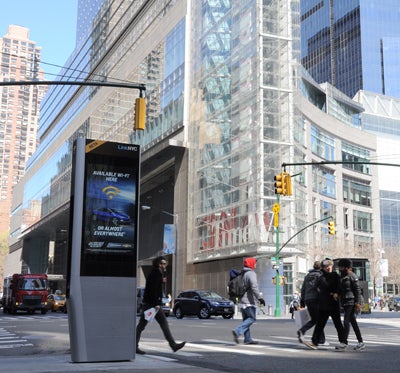
 New York City has more than 8,000 public pay phones, most of which are in various stages of decline and decay – but Sidewalk Labs, a company under Google’s Alphabet umbrella, is helping put a plan in motion to revive those aging kiosks.
Through a project called LinkNYC, the city’s neglected phone boxes are in the process of being replaced with nine-and-a-half-foot-tall structures complete with 55-inch digital displays on each side and access to free, fast Wi-Fi and other services like audio calls, maps and directions.
If it all goes according to plan – the first step of this complicated process requires laying down hundreds of miles of virgin gigabit fiber – brands will be expected to foot the bill with advertising.
Targeting is fairly basic at the moment, said Dave Etherington, chief strategy officer of Intersection, the Alphabet-backed startup charged with bringing LinkNYC to life. The ads will rotate on the displays depending on contextual signals like time of day, weather conditions and the neighborhood where the kiosk is located. No ads will be served into the actual surfing experience.
Although Google isn’t directly involved with Intersection, when the name Google, or in this case Alphabet, enters the scene, the question immediately turns to privacy – because the revamped phone booths aren’t just hotspots providing people with free Wi-Fi, they’re also collecting data. Users sign up for the first time with their email address, after which they’re hooked into the system.
Intersection spent several months hammering out a privacy policy with New York City, Etherington said. The upshot: “We can never give away or sell personally identifiable information to a third party,” he said, though Intersection might collect anonymous data in the aggregate for city planning purposes or to track trends.
As of now, there are 175 Links live up and down Third Avenue, Eighth Avenue and sections of Broadway in New York City. The goal is to have 500 online across the five boroughs by July. There have been more than 1 million free Wi-Fi sessions initiated through the Link network since January.

Other urban centers are also on the docket, although Intersection is keeping quiet on where for the moment.
Officially, the LinkNYC initiative is being spearheaded by CityBridge, a consortium of companies that includes Qualcomm, out-of-home transit ad company Titan and outdoor digital design company Control Group. In 2015, Titan and Control Group merged to form Intersection. Sidewalk Labs – Alphabet’s urban innovation unit and one of the “other bets” in Google’s growing portfolio of moonshot investments – has a financial stake in Intersection.
Intersection hopes to generate around $500 million in revenue for NYC over the next decade or so.
AdExchanger caught up with Etherington for a peek inside Intersection.
AdExchanger: Why focus on free Wi-Fi?
DAVE ETHERINGTON: Two things: One, New York has thousands of old, anachronistic public pay phones that aren’t being used, and two, there are around 2.5 million people in New York without access to broadband, a fact mirrored in most cities across the US and the world. More people than ever live in urban areas and the need for data is growing exponentially. Broadband Internet access was even recently made a universal human right by the UN.
But the reason free Wi-Fi hasn’t worked in the past is because of the absence of a workable financial model. That’s where advertising comes in.
What sort of data collection can you do?
We’re still trying to understand what the impact of thousands of digital displays across the city will be and what we might be able to do with the data to fuel an interesting advertising experience. That’s still a work in progress since we only started deploying this in January.
 What about the targeting piece?
We’re working on that right now. Broadly speaking, the logic here is based on three things: location, time and an understanding of audience, which is enabled by the TAB [Traffic Audit Bureau], the standard industry measurement service for all out-of-home media. They measure the number of audience impressions and translate them into demographic groups for us. Adding time plus location allows us to add an extra layer of granularity.
Are there already advertisers using the platform?
We’ve worked with GM and Chevy to promote their in-vehicle Wi-Fi. We also ran a campaign for MillerCoors along with Shazam. Using beacon technology, we allowed Shazam users to listen to top 10 playlists based on microlocation according to time and neighborhood. In Chelsea, for example, Sade was the top artist. In Turtle Bay, Sonny Rollins was No. 3. And then, after David Bowie died, we watched everything turn to a Bowie playlist.
It was a way to use third-party data to witness something happening in real time, and a brand was able to facilitate that.
What kind of metrics can you provide back to your advertisers?
It used to be that when you saw ads in physical locations, there was no context or value exchange between the brand and the consumer. There was an ad there and you either saw it or you didn’t. Link changes that.
That said, we have the same metrics or absence of metrics that all physical displays have at the moment, although each Link does have a beacon in it, so if we’re doing a beacon-enabled campaign like with Shazam we can monitor the amount of interactions we get. There is also some thought around using beacons to work with retailers around attribution, to see if someone exposed to a message in the physical world changed their behavior geographically.
Are you taking advantage of Google Fiber?
Right now, there’s no plan to connect to Google Fiber. We’re laying all the fiber ourselves.
Considering the Google connection, how do you approach privacy?
We have a shared sensitivity around data and our interactions with Alphabet are all through Sidewalk Labs.
Our three focuses as an organization are citizens, cities and commerce – making sure we build products that citizens will use, that we bring value to municipalities and work within their guidelines and enabling all of this to fund itself. The backbone of all of that is ensuring that we stay on the right side of things like privacy and security. We don’t share any PII.
But brands are excited because this isn’t just about communication. This is the opening gambit toward a fairer, more responsive, smarter city for everyone.