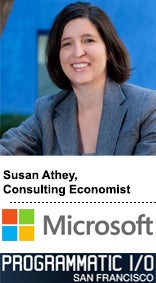
 Susan Athey will speak at AdExchanger’s PROGRAMMATIC.IO conference in San Francisco on April 14.
Academia has a unique role to play in supporting the digital economy, as its members bring a completely different perspective to studying ad auctions.
The academic underpinning of ad auctions isn’t new – Hal Varian, Google chief economist and early AdWords designer, was also the founding dean of Berkeley’s School of Information, while another Berkeley professor, Steve Tadelis, was given unprecedented research access to eBay’s advertising data for a study that led to the retirement of the company’s search offering.
“It’s nice to have academic researchers doing this, because everyone knows [large companies] overestimate the effectiveness of their own ads,” said Susan Athey, a Stanford economics professor and long-term consultant with Microsoft. “It’s becoming more common because in-house data scientists fill a different role and they’re not incentivized to say, ‘Hey, my advertising is broken.’”
Athey spoke with AdExchanger about the role and value of academic research within the world of advertising auctions.

AdExchanger: Why do tech companies, and ad tech ones in particular, turn to economics professors?
SUSAN ATHEY: There are a lot of applications for microeconomics. With billions and billions of auctions per month, a lot of nuanced economic ideas come into the rules for an auction and how you introduce news products or integrate them into the market. And because these are so new, there’s no playbook for how this is done. You can’t just call McKinsey and ask for a solution.
How might an economist look at a new product or rule introduced to an auction?
One scenario we’ve considered is a platform deciding whether or not to have two engineers work for two months to build a tool for sellers, or to continue having sellers handle the inefficiency themselves by spending an additional hour or two per week working on the technology. If you build that tool, it may not have an immediate uptick, because it increases business slowly and could take months before there’s wide adoption. So it’s very hard to measure the benefit if you’re looking at day-to-day value or short-term A/B tests. But from a longer-term economic perspective of value creation, it’s very clear. You have two engineers working on it over a couple months vs. maybe thousands of partners spending an extra hour or two every week. Even if the value accrues to the sellers and the platform gets only a fraction [of revenue], it’s still beneficial on aggregate.
What are the kinds of companies interested in consulting academics?
Most major tech companies have economists, which includes a mix of full-time employees with academic consultants. I know Netflix, Uber and Airbnb are pursuing similar models – any tech company with that platform dynamic in their model. Amazon has a number of economists that do 80/20 splits where they do consulting work most of the time, and then the other 20% is more academic projects.
You’ve done research on US Forest Service timber lot auctions. Does that relate to work you do around platform economics and ad auctions?
One of the insights that came out of my work on timber auctions was the way the rules of the auction matter in how it affects the distribution of outcomes across different bidders. You impact participation if the auction is skewed toward the biggest bidders, and those running auctions tend to focus on the pricing levels and not how they’re fostering participation.
Moving over to the online ad auction world, it can be tempting to take a short-run perspective. But if the rules of the markets are such that small bidders don’t earn a lot of profit, then they won’t come or be engaged. That isn’t going to show up in an A/B test or if you’re evaluating a narrow time frame. You need to have longer economic logic. Think about how what you’re doing affects participation. If you have lots of companies earning profits, that helps drive customization to your platform and the overall health of your market.