

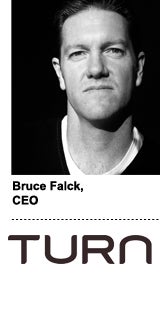
 Turn is going through a restructuring and has laid off 57 of its roughly 400 employees, said company CEO Bruce Falck, who was appointed to the role in September.
“We did a pretty big restructuring of client services and sales,” he explained. “We merged the team, so it’s true that’s a larger chunk. But we’re paring back everywhere.” That includes business development, human resources, marketing, and several management layers. No other layoffs are expected after this round.
It’s a drive to cut costs, as the company has been losing money – despite having raised $80 million in January 2014. A source with knowledge of the situation said Turn recently had $35 million in the bank. Falck anticipated by the end of the year, it will have $25 million.
“The company was in go-big-and-go-fast mode [when it raised the $80 million],” Falck said. “There’s been a slowdown where we want to preserve our cash and build the business for the long term.”
While Turn has an excellent platform, according to the source, past management decisions have led to its decline. For instance, under former CEO Bill Demas, it doubled down on the SaaS business model where, like Salesforce.com, brands would pay a monthly fee to access Turn’s technology. It brought in former Lyris CEO Wolfgang Maasberg to oversee its sales initiatives in this area. But Maasberg left Turn October 2014 and is now in sales at Oracle Marketing Cloud. Demas also left the company last April after struggling to make the company profitable.

Falck ultimately feels the market wasn’t ready for Turn’s SaaS approach.
“We’re an omnichannel DSP. I want to focus on that and getting large customers to scale,” he said. That means investing heavily in areas like video. “There’s no need to reinvent the pricing model.”
So while the SaaS model continues to exist, Turn is moving away from it. “We’re doing the standard platform percent-of-media type deals,” he said, adding most of the SaaS work is happening around Turn’s data management platform.
The problem with the SaaS model is that many clients wanted an old fashioned I/O process, or they just wanted to buy media, not license technology.
Meanwhile, competitors offered pricing models buyers were more comfortable with than a monthly tech fee – like pricing based on a flat CPM or the percent-of-media deals that Turn is now embracing. And the 13-14% tech fee Turn charged wasn’t enough savings to entice prospects – especially against competitor tech fees of 15%. Clients wanted at least five points difference.
Despite its restructuring, Falck said Turn will continue selling to agencies, trading desks and directly to brands. Its relationship with Kraft and the brand’s agency Starcom remains its poster child partnership.







