Alphabet posted revenues of $32.3 billion in the fourth quarter of 2017, up 24% compared to the same period last year.
The earnings showed a spike in traffic acquisition costs [TAC] as Google paid more to publishers in its Google Network Members’ properties revenue segment. The segment also includes revenue from Google’s DoubleClick Bid Manager, AdMob and Google AdX.
The traffic acquisition costs increased so much that Google actually earned less year over year from the members’ properties segment.
In 2016 Q4, Alphabet earned $1.35 billion from those properties, but that figure dipped to $1.32 billion in 2017 Q4.
That decline happened even as the properties segment grew 13% to $5 billion in Q4, Alphabet CFO Ruth Porat said, with the segment showing “healthy growth.”
Google only took 26% of that $5 billion in revenue, down from a 29% cut in the prior quarter and 30% in Q4 2016.
The increase in TAC could be a “means toward capturing incremental share of advertiser spend from competitors and a way to drive top-line gross revenue,” noted Brian Wieser, senior analyst at Pivotal Research.

In other words, Google may be lowering its rates to stay competitive.
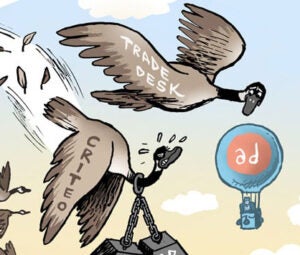
The trend of margin compression has been playing out in the programmatic space – most notably for the much smaller, struggling programmatic sell-side public company Rubicon Project. But fear of margin compression also contributed to The Trade Desk’s stock decline over the past quarter.
Google offering more to its partners via higher TAC suggests that even large companies see the need to lower their programmatic “tech tax.”
The amount of TAC paid to Google Network Members’ properties (now 74%) increased much more slowly over the past three years. In Q4 2014, Google paid 68% to publishers. In Q4 2015, that figure increased to 69% and then to 70% in Q4 2016.

“The underlying trend affecting the network TAC rate year over year continues to be programmatic, which carries higher TAC,” Porat said.
However, the revenue Google earns from AdX, DBM, AdMob and AdSense is just one-fifth of what it earns from its own properties, including search and YouTube, meaning the impact of flat revenue in this category isn’t as notable.
Performance in Google properties showed incredible strength. Revenue increased 24% on Google properties, the category that includes search and YouTube. Although TAC paid to partners rose 2%, Google still brought home an extra $3.3 billion, an increase in revenue of 20%.
Plus, although Google paid more in TAC on its own properties because of high costs in mobile search, it said it expects TAC to stabilize in the following quarter. Google made no such prediction for TAC on the Google Network Members’ properties.
In addition to paying more to publishers, Google paid out more to the government.
The stock beat on revenue but missed on earnings per share because of nearly $10 billion in extra taxes Google must pay because of the recently passed Tax Cuts and Jobs Act. That news sent the stock down 2% in after-hours trading.