Traffic is down at Facebook.
It’s a new look for the platform, which has done almost nothing but grow quarter over quarter and year over year.
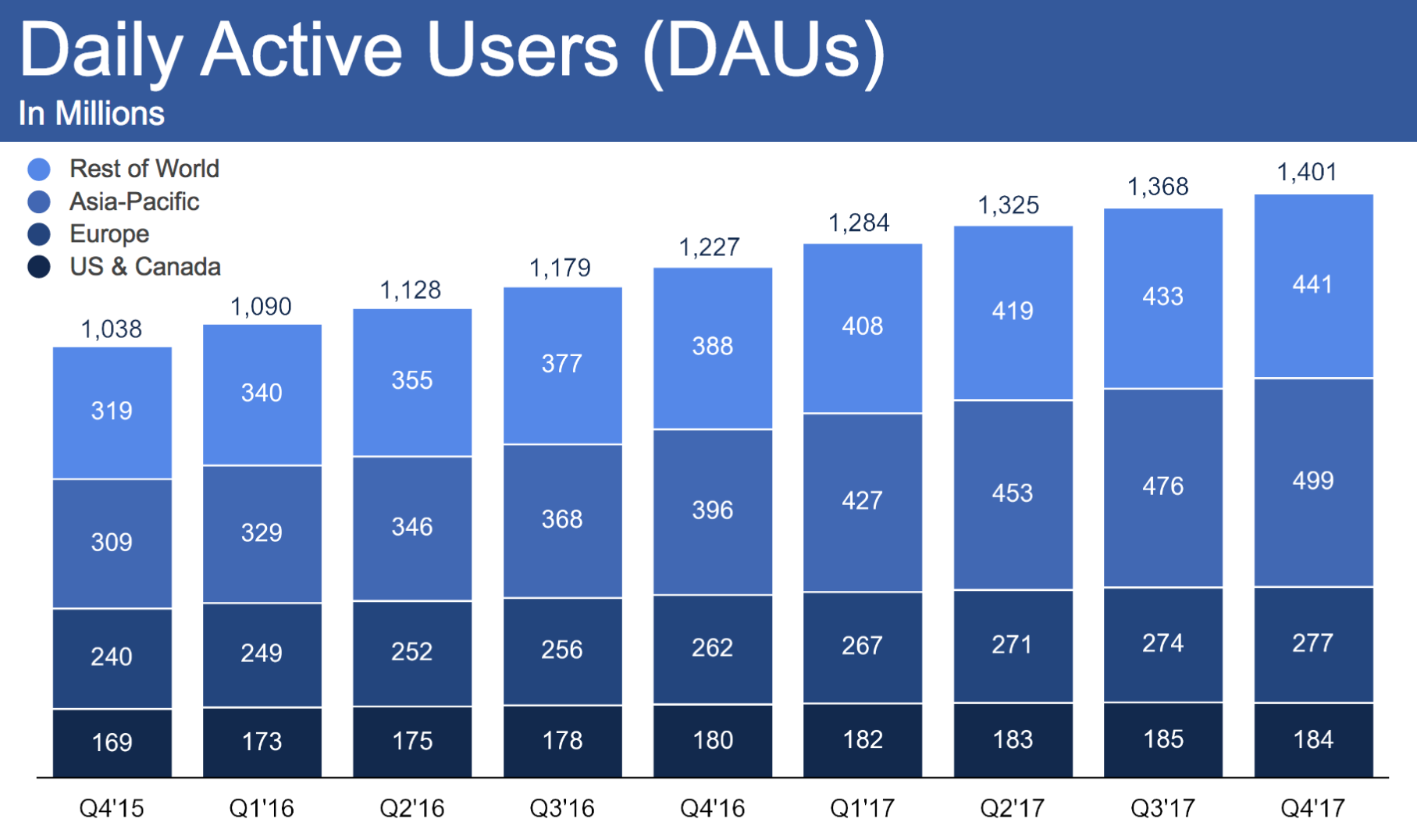
Changes to Facebook’s news feed algorithm deprioritizing viral video in Q4 reduced time spent on the platform by around 50 million hours a day. Daily active users in the US and Canada declined by 700,000.
Although DAUs and monthly actives were both up 14% year over year, hitting the 1.4 billion and 2.13 billion marks, respectively, in December, quarter-over-quarter growth appears to be slowing down. DAUs increased nearly 4% in Q3 compared with just 2.18% this quarter.
Although Facebook CFO David Wehner said he believes the DAU dip in North America is a blip and not “an ongoing trend,” the decline could be a sign of engagement headwinds in quarters to come.
Despite beating the street – total revenue was nearly $13 billion for the quarter, up 47% YoY, with mobile ads account for $11.4 billion – shares took a tumble in after-hours trading.
Updated, 2/1/18: The stock recovered Wednesday evening after the earnings call and was up nearly 1% in premarket trading, hinged on Wehner’s statements that the average price of ads rose 43% in the fourth quarter across Facebook and Instagram and that changes to the news feed won’t materially impact monetization.
Facebook plans to continue making quality changes to the news feed with the goal of generating more social interactions on the platform, and that will likely lead to more drops in time spent.

But if a reduction in passive content consumption is the price Facebook has to pay for more quality engagement, that’s okay, Mark Zuckerberg said.
“If we do our jobs well, this should increase the number of meaningful interactions people have, and we think that is going to be positive and help make our community stronger over the long term and be good for the business over the long term,” he said.
It’s also possible that people are just starting to spend less time on Facebook, which has been battling growing trust issues, fake news and a Russia-shaped headache for the better part of a year.
One investor questioned how Facebook could be sure that the 50 million hour tumble in time spent was a result of proactive changes to the platform versus circumstances not within Facebook’s control.
Zuckerberg mainly skirted the question.
“Time when people are engaging and building relationships is good time,” he said.
Zuck also acknowledged Facebook’s other ongoing challenges.
“2017 was also a hard year,” he said. “The world feels anxious and divided and that played out on Facebook.”
Recent and ongoing tweaks to the platform, he said, is a response to those anxieties, and to “make sure our services are not just fun” but also good – or at least not actively bad – for society.
But what Facebook deems as good for society doesn’t align with what publishers deem necessary for their survival. A recent change to Facebook’s algorithm that prioritizes content from friends and family over content produced by businesses effectively cut off the news feed as an organic distribution channel for publishers.