Did Facebook’s algorithm force the Clinton campaign to pay more for ads than the Trump outfit during the 2016 US presidential election?
That’s fake news, said Facebook, which provided a rare public statement on the dynamics of its ads auction on Tuesday after claims of discriminatory pricing.
Senior Facebook exec Andrew Bosworth disclosed on Twitter that the Trump campaign paid consistently more for ads on Facebook than the Clinton campaign from late June through early November 2016. He tweeted the chart below on Tuesday afternoon.
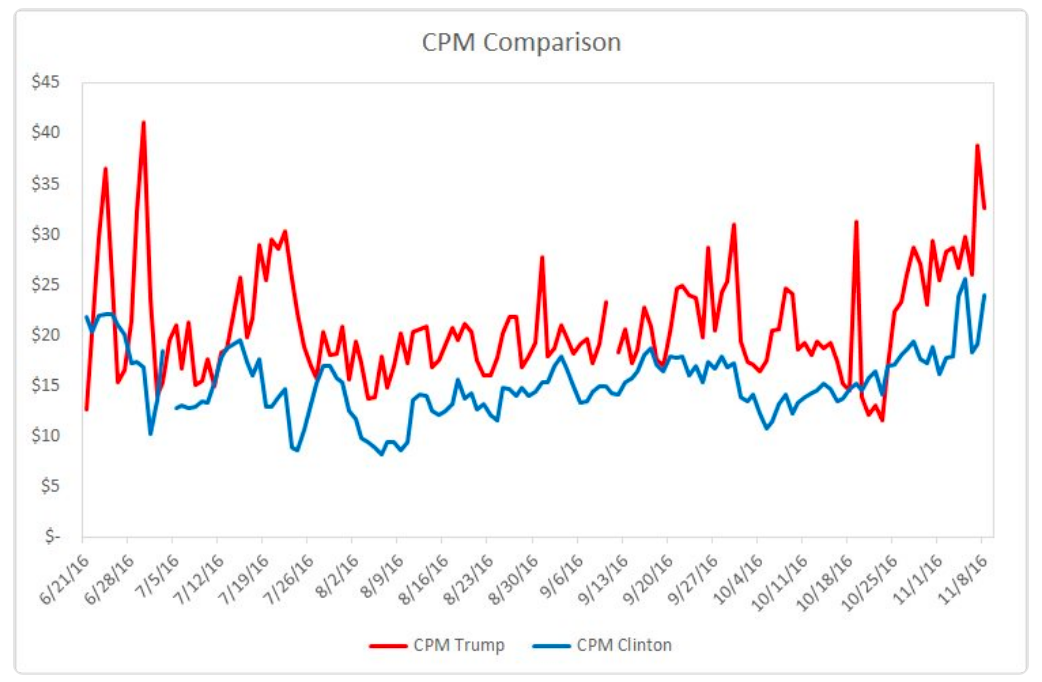
It’s unusual for a tech platform to provide this level of transparency about its ad pricing. However, Facebook’s hand was apparently forced following boasts by Trump’s digital campaign director, Brad Parscale, on Twitter Saturday that then-candidate Trump paid “CPMs that were pennies in some cases,” and that Clinton likely shelled out 100 to 200 times more for the same ad space.

The speed with which Facebook responded indicates the priority senior management now places on addressing claims about its role in the presidential election.
So who’s right?
Parscale didn’t say how he knows Clinton paid 100 to 200 times more for ads than Trump. Perhaps CPMs were actually “pennies” on certain days in particular rural areas. Advertising costs go down in cheaper geos.
This mini tempest also highlights that Facebook’s auction doesn’t exclusively reward the highest bidder, but also factors in whether an ad is likely to generate engagement. The type of incendiary and polarizing messaging associated with the Trump campaign, in theory, generates what former Facebook staffer Antonio Garcia Martinez calls “a feedback loop” that optimizes outrage.
But Bosworth took umbrage with the notion that clickbait costs less to promote on Facebook, asserting on Twitter that the Facebook auction favors “good creative,” but only with a 10% boost in either direction.
Ad prices on Facebook also depend on factors like the size of the audience and the campaign objectives, which likely fluctuated by candidate over the course of the election.
As Boz tweeted late Monday, “Remember, price for any given impression is determined by an auction so by definition this pricing cannot be discriminatory.”