
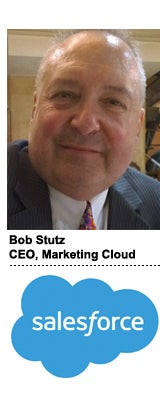
 Salesforce has named CRM technology pioneer Bob Stutz as CEO of its Marketing Cloud, replacing outgoing CEO Scott McCorkle.
McCorkle, a soft-spoken and well-liked exec, has for the past two years driven the marketing tech bus at Salesforce, a bus that has arguably been stuck in a fast idle since the company paid $2.5 billion for ExactTarget three years ago.
Stutz is a different kind of leader. He was an early builder of CRM technology and is considered a visionary in that space, having worked at Siebel Systems in the late ’90s and leading SAP’s first CRM applications before heading to Microsoft. Stutz was first hired by Salesforce in 2015 as chief analytics officer, and his appointment to run Marketing Cloud is a sudden promotion.
Reading the tea leaves, what does the shuffle say about Salesforce’s strategic focus? Some things to consider:
1. Stutz’s hire comes at an inflection point for Salesforce and the whole market, according to Gartner research VP Martin Kihn.
“Nobody’s quite sure where the market’s going, particularly the convergence between marketing and ad tech,” Kihn said. “And there are big questions around ad tech in general as Facebook and Google gobble up ad spend. It does appear there are winners and losers in ad tech, and nobody wants to get caught up on the losing side.” Hence, the preferred strategy among Salesforce top brass may be to wait and watch.

2. Salesforce appears obsessed with commerce right now. The company just completed its $2.8 billion acquisition of ecommerce platform Demandware. Commerce is an exploding market projected to grow from $335 billion in 2015 to $523 billion in 2020 in the US alone, according to Forrester. While the integration of ExactTarget was completed recently, any company acquired by a global enterprise knows that first you’re the kitten, and then you’re the cat. And it can be hard for the cat to get attention when there’s a new kitten around.
“In terms of mar tech, they’re realizing that’s a maturing market. There are only so many emails that can be sent,” Kihn said. “The next frontier is probably commerce.”
3. Company CEO Marc Benioff himself appears to have very little interest in advertising. In public comments, Benioff often describes Salesforce as a “customer” company.
On the other hand, Salesforce is hugely invested in marketing, to the tune of $3 billion in M&A plus significant expenditures post-acquisition. Its core components are email marketing and social advertising. And its Active Audiences solution lets Salesforce users apply known customer information to reach their customers in digital channels via Journey Builder. It also has a significant foothold in B2B marketing automation via its Pardot product. The company isn’t about to walk away from those investments.
“There’s no piece of what they have that’s any less important than any other piece, even though some are cash cows,” said Paul Greenberg, owner of management consultant The 56 Group and an adviser to Salesforce. “As far as the marketing piece goes, it took them a long time to get where they’re going.”
And while the company’s interest in paid media has largely focused on social, “people-based” ads to the exclusion of higher-funnel channels (“It’s very much this CRM version of advertising,” Kihn says), its social ad presence is huge. Salesforce is the No. 1 partner to Facebook’s Custom Audiences first-party data matching program.
Stutz will certainly maintain these investments in the short term.
According to Greenberg, Stutz is hugely admired in the CRM world, and may have the organizational chops to tightly integrate Marketing Cloud with Sales Cloud, Service Cloud and all the other products in Salesforce’s cloud city. “It takes guys like Bob to take a teenage product and make it mature,” Greenberg said.
The question for many observers in the advertising sector is whether Salesforce will extend its investment in paid media beyond known customers to reach more unknown prospects high in the purchase funnel. Recent developments offer no reason to think so.