 GhostBed is ready to go to the mattresses to gain share of voice in the super-competitive bed-in-a-box market. One tactic in its arsenal: cars wrapped in advertising.
“It’s like a moving billboard – you’re getting an enormous number of impressions and it’s cost-effective for us,” said Marc Werner, CEO and founder of Nature’s Sleep, manufacturer of the GhostBed, a memory foam mattress aimed at millennials, in the same vein as Casper.
(Casper is a touchy subject, though. Werner is actually suing his competitor in Florida Southern District Court for intellectual property theft.)
GhostBed goes heavy on digital marketing – it’s actually one of Facebook’s most prolific advertisers – but it’s also looking for creative ways to get the word out.
For that, the brand is turning to Wrapify, an app that, like its competitor StickerRide, connects consumer drivers and brands looking for exposure.
The drivers have their vehicles sheathed in an ad and get paid per mile for driving in specific areas laid out by the advertiser.
Wrapify recently launched its Android app – before it was just iOS – which expanded its driver pool by around 10,000, bringing its total driver user base to more than 35,000. The platforms already live in 27 cities across the US, including Boston, Los Angeles and New York.
Impressions are calculated by matching a driver’s latitude and longitude with anonymized third-party data from carriers and data aggregators like INRIX, which provides real-time traffic reports from traffic data gathered via smartphones.

Wrapify keeps its drivers honest by tracking their movements through a Bluetooth device in their car connected to the Wrapify app. Brands can access a dashboard with real-time analytics about their campaign, including live impression data, geographical reach and where the cars are driving in real time.
The accountability aspect is what makes the offering compelling, said Wrapify CEO and founder James Heller.
“We’re looking to bridge the gap between digital and out-of-home,” said Heller, who spent the majority of his career prior to Wrapify in the B2B digital marketing space, where “every dollar I spent had to be tied to some metric” or he couldn’t justify it.
“I was always interested in out-of-home, but I never had the opportunity to consume it as part of a campaign because it was too difficult to tie a flight of billboards or bus shelters to results,” he said.
The majority of spend on the Wrapify platform comes from a reallocation of traditional out-of-home budget – about 70%. But some clients, such as Petco, classify Wrapify as part of their digital media plan.
 “We are cannibalizing billboards and traditional transit OOH like bus shelters, but we consider ourselves to be a digital ad platform,” Heller said. “The big difference is that instead of an online banner ad, we’re sending out wrapped vehicles on the road.”
Although GhostBed can’t connect its spend on Wrapify to specific mattress sales – it’s got multiple campaigns running in various markets, including San Francisco, Chicago and Miami, and plans to spend north of $1 million on the platform by the end of the year – Werner’s finance folks have observed an uptick in mattress sales that correlates to its Wrapify efforts.
And Werner is more than happy to use the platform as a top-the-the-funnel tool.
“It’s about presence, mindshare and awareness,” Werner said. “There’s generally a three- to four-month gestation period before we see results, but that’s okay because there’s a 90-day gestation period for a mattress purchase anyway.”
GhostBed also uses Wrapify’s “swarm” feature that acts like an on-demand event activation button. Advertisers send a push notification to drivers requesting that they converge on a particular location at a particular time to generate buzz.
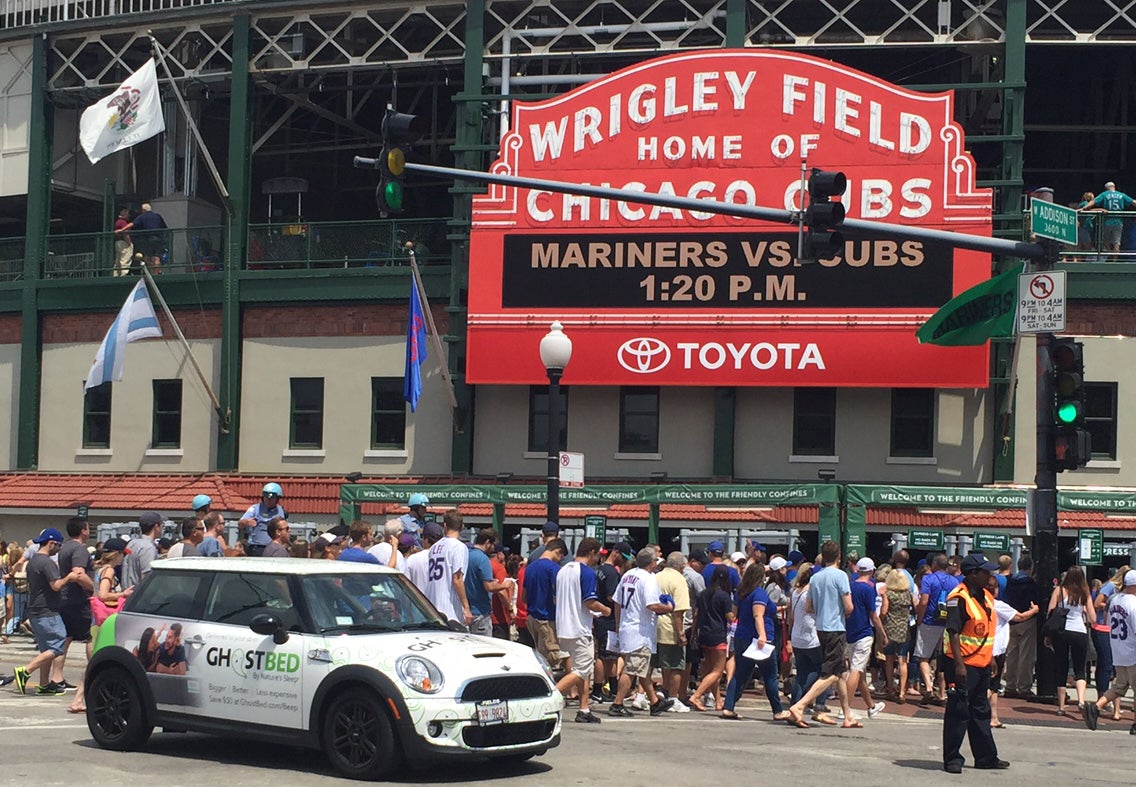
GhostBed uses the feature to piggyback on its sponsorship of the Chicago Cubs to get GhostBed branded cars driving around Wrigley Field on game day. It does the same for Bears games at Soldier Field.
The wrapped car gambit might be top-of-the-funnel, but it helps keep GhostBed top-of-mind, Werner said, and that allows GhostBed to buy branded keywords rather than the far more expensive category keywords like “mattress” or “mattress in a box,” which can run as high as $15 or $18 per click.
“If we can generate enough awareness to drive people to our website at a lower cost, we know we’ll make the sale,” he said.
And there’s a lot of cash to go around. Mattresses are a roughly $15 billion-a-year business in the US, and competition is fierce in the bed-in-a-box category.
“We’re getting hundreds and hundreds of millions of impressions a month – that’s a lot of fricking impressions,” Werner said. “And, frankly, we don’t need too many click-throughs to have success.”