

 Apester, a self-described digital storytelling platform, rounded out its Series A on Tuesday with $12 million, bringing its total funding to $17 million.
The fresh infusion, which came after an initial $5 million round in July, was led by Blumberg Capital, with participation from Mangrove Capital, Wellborn Ventures and several others.
The cash is earmarked for three main purposes: R&D, hiring salespeople and international expansion beyond existing offices in New York, Tel Aviv, London, Berlin, Tokyo and a soon-to-open outpost in Istanbul.
“We’re trying to meet digital publishing needs, and that’s not market-specific,” said Apester CEO and co-founder Moti Cohen.
Those needs include increasing engagement and time spent, both of which are acutely lacking in the mobile and social referrals that comprise a larger and larger portion of overall traffic.
According to AddThis, most social referral traffic bounces after landing on the first page.
“Social usually acts as a way to get someone from one point to another, but they’re unlikely to dive into other articles, let alone advertising,” Cohen said.
Apester’s approach is to try and limit the bounce rate by adding elements to the page that spice up the editorial and keep users from heading out after reading the headline and scanning a couple of paragraphs.

The technology works by integrating into a publisher’s CMS. From there, publishers can embed interactive units – quizzes, polls, personality tests and videos – directly into content so that they look like a native elements of the story.
Although funding in the ad tech space is notoriously running dry, native advertising still seems to be able to bring in the bucks. Survey and quiz platform Playbuzz, for example, one of Apester’s top competitors, raised a $15 million strategic round in late March led by Saban Ventures with pinch-hitting from Walt Disney Co.
Apester’s platform also collects user feedback, preference info and sentiment-related data based on a reader’s engagement, which it supplies back to the publisher and uses to help recommend more relevant content to keep the reader reading.
Some Apester clients use the tool to enhance their editorial output, while others use it to power their sponsored content, including The LAD Bible for McDonald’s, The Weather Channel for Michelin and The Huffington Post, which used an Apester unit to house editorial content created as part of a commercial campaign with Clorox.
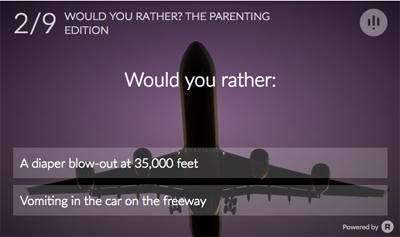
A “Would You Rather?” quiz written for Huffington Post’s Parents section – (one pertinent question: “Would you rather step on a LEGO or be head-butted by a toddler?”) – was used to encourage engagement with Clorox-branded “Don’t Stress The Mess” content developed as part of HuffPo’s ongoing content partnership with Clorox.
The quiz had a 72% click-through rate, and nearly 5,000 of the readers who engaged with the poll went on to read other Clorox-related articles on HuffPo’s site.
Entertainment Weekly created an interactive video on the 40th anniversary of the release of Queen’s “Bohemian Rhapsody” that prompted readers to test their knowledge of the song’s lyrics. The video garnered a 56% engagement rate despite its placement at the bottom of the page, a 93% completion rate and an average time spent rate of six minutes.
UK publisher The Telegraph created an interactive quiz to accompany a story entitled “Who said it: Donald Trump or Adolph Hitler?” The quiz generated a 14% click-through rate and more than 60,000 engagements the week it was published.
“We use the same mechanisms for brands and for advertisers,” Cohen said. “There’s no point in disguising yourself. If you bring value, it doesn’t matter if you’re a brand or not. Look at Red Bull and extreme sports – I mean, it’s just an energy drink, but people engage like crazy.”
Founded in 2011, Apester first hit the market at the end of 2014. Over the last year, the company upped its headcount from eight to 50, a number it plans to double by 2017 using funds from this most recent round.








