 Publishers are still working out journalism on mobile devices.
While basic responsive design is usually a given today, mobile article formats haven’t dramatically changed. Most innovation happens on platforms like Facebook Instant Articles and Snapchat Discover – not on owned-and-operated sites. Which is why Quartz’s app, a conversational news app launched in February, is a fascinating use case for publishers trying to crack mobile.
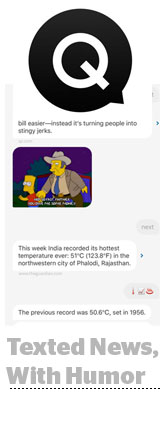
The news app presents the latest news as if your friend texted it. Users respond in choose-your-own adventure format, deciding to read on (often via an emoji) or go on to the next article (“next”).
While Quartz site has always been mobile-first, that design always had to account to users accessing the site on tablet and desktop too. But Zach Seward, who heads product for Quartz, wanted to find out what would it look like “if journalism was truly made for peoples’ phones.”
One year of development later, Quartz released its mobile app, “the first, we hope, of many products” designed for the phone, Seward said.
Quartz thought about how to integrate advertising early on in app development. Native ads appear in the same conversational format. Mini Cooper was the launch sponsor, and Quartz has already sold out ads for the year, in part due to light ad loads.
“The sponsored messaging is shown one time per campaign per user,” said Mia Mabanta, director of marketing and revenue products for Quartz. “On one hand, that is counter to how advertising works. But we were not going to have any success if the user experience was compromised.”

According to Quartz, hundreds of thousands of people have downloaded the app since launch. Some users love it – others hate it.
“Unlike the web, most mobile products actually benefit from being polarizing,” Seward said. “By that, I mean it’s polarizing in both directions. Our daily active users are coming in two times a day, and you only do that with a product you actually love.”
That’s why Quartz built its app with personality by including emojis and GIFs to illustrate stories.
“The second-to-last alpha had a very similar look and feel, but very critically lacked the way it has a personality [now],” Mabanta said.
Quartz’s app is not a chatbot, though it shares the same conversational format as Kik and Facebook bots, since it’s manually programmed and delivers a similar experience to all users. As other publishers dip their toes into the world of sending content via messages, Quartz has some advice.
“There has to be a reason why you are doing it in the form of the bot or the conversational use case,” Seward said. “Think about the user first before chasing the trend.”
Publishers also need to respect and understand mobile, period, whether users access content through a mobile bot or something else.
“The point I would underscore is the delicateness of mobile,” Mabanta said. “As they explore potential bot integrations, media companies and brands should not overlook how different user behaviors are on mobile vs. desktop.”