

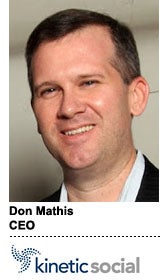
 Social ads company Kinetic Social has raised $8 million in a round that includes both equity-based cash and an expanded debt facility. Kinetic will use the money to ramp up its social ad optimization technology, which works across social media platforms including Facebook, LinkedIn and Twitter.
Cincinnati-based Blue Chip Venture Company provided the equity piece of the round, worth $5 million, while Gibraltar Business Capital has added $3 million to a pre-existing debt option. The raise brings Kinetic’s total funding to $11 million.
Kinetic is focused on big brands such as Mars, which has given it a major contract for 2013. Many other brands are testing it out using RFP budgets in the realm of $15,000, says CEO Don Mathis.
The aim is to transcend from simply a buying platform, a position to which many Facebook Ad API vendors have been relegated.
Mathis says, “Our best use cases are when we work with a particular client over most or all of our product offerings, with a campaign that is integrated across those offerings; when we sit with the brand personnel as well as the agency personnel at the table, and we’re operating at the level of the brand’s annual or quarterly communications plan; and when we’re engaged in a robust conversation around the campaign analytics, learnings and evolving strategy.”

As an example of its cross-platform focus, Kinetic will often begin with a broad-based awareness campaign on Facebook and then perform a “Twitter blitz,” targeting traffic in a particular geography for a six- to eight-hour period. Twitter made up 12% of Kinetic’s business as of late last year.
To many, it seems the landscape of social ad buying platforms has been rapidly commoditized – and in the case of Facebook perhaps marginalized, as Facebook Exchange vendors bring sources of RTB demand that can easily outbid the standard API. But Kinetic is betting that it’s early innings for social marketing, and that the winners will bring special-sauce optimization to multiple APIs.
Companies such as Facebook, LinkedIn and Twitter are watching their marketing partners more closely than ever, as evidenced by the introduction of higher standards to Facebook’s Preferred Marketing Developer Program. It’s increasingly imperative that vendors perform not only from the buyer’s standpoint, but the social platforms as well.
“Facebook and Twitter and LinkedIn – and hopefully soon Pinterest and Foursquare – make more money because we’re able to bring almost an R and D shop to them,” says Mathis.
Kinetic has grown from 19 to 49 employees since it was spun off in 2010. It is not yet profitable and seems in no special hurry to change that, having spent just $72,000 on marketing in 2012. But the company is hiring a CMO now, and Mathis suggests this year will bring a larger marketing investment – but he says the company is proud of its scrappy way of doing things.
What about SaaS and the trending idea of providing a dashboard solution to agencies and brand-side buyers?
“We recognize the need for an integrated platform on which our clients can ‘turn the knobs,’ so to speak, but we’re not building the business exclusively around that concept,” says Mathis. “Fundamental to the business is that you must target and perform better than the competition, so that’s where most of our focus remains.”
Backstory
Kinetic has suffered by association with its previous parent company, Epic Media Group, which ran afoul of federal regulators last year; the FTC targeted EMG for engaging in “history sniffing” of user browsers. When Kinetic emerged from the ashes of that company with many of the same employees, eyebrows were naturally raised (including by this publication).
It eventually emerged that the privacy violations were tied to Connexus, a company that acquired EMG. Mathis stepped out of the leadership role post-merger but was later brought in to fix things when the privacy ugliness came to light. “I was asked to stick around because I had restructuring and turnaround experience,” he says.
As acting CEO at EMG, he began to incubate Kinetic while simultaneously disentangling the parent company from its privacy issue, a process that eventually led to a settlement with the FTC. Mathis offers no excuses for the history-sniffing activity and only regrets not having acted faster when it came to light.
“We live in a time where it’s important for the voices on the privacy side to be heard. The industry has a natural tendency towards defensiveness around privacy matters, and I think that’s wrong-headed. We would all do better as an industry to ensure no sense of mistrust for the consumer and an ability to interoperate with ecommerce and advertising sites without being creepy or invasive.”






