

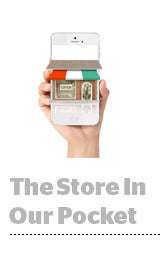
 “Stores as we knew them are over,” said Lee Peterson, EVP of brand strategy and design at retail consultancy WD Partners at the 2015 National Retail Federation Big Show in New York City on Monday.
For this, we can blame – or credit – the mobile device.
According to research by WD Partners, in-store visits have fallen at least 5% every month for the past 30 months. The decrease in foot traffic is a potentially alarming development for brick-and-mortars – but overall retail sales have been up since January 2014.
Holiday foot traffic in 2014 was down 8.5% year over year – but overall holiday sales this year were up 4%. Holiday foot traffic in 2013 was down 50% compared with 2010, while Internet sales have increased every quarter by at least 15% for the last two years.
Seventy percent of millennials rated customer reviews as more important to them in their shopping journey than touching and feeling a product in the store. “There are 80 million people in the US who are considered to be millennials, and they don’t care about touching and feeling your product,” Peterson said.
On the surface, the big picture being painted is clear: “Mobile plus warehouse equals the store of the future,” said Peterson. “But we can’t let that happen. We have to do something with stores. We have to make stores better.”
One way retailers can try and deal with the “fulfillment emergency” is something Peterson referred to as BOPIS, another acronym for the arsenal: Buy online/pickup in-store.

According to WD Partners, 4% of consumers who placed an order online selected in-store pickup over delivery in 2013. That number shot up to 64% in 2014.
Of 1,500 consumer surveyed by WD late last year, 65% of millennials selected drive-through as their preferred BOPIS method, with others pointing to parking lot kiosks (37%) self-serve lockers (29%) and combined retailer (29%) as other appealing options. [“Combined retailer” refers to a single nondenominational pickup point where consumers could retrieve all of their online purchases, regardless of brand.]
This all seems to point to the fact that stores are a bore and that the 80 million millennials in the US want nothing to do with them – but that’s not necessarily the case.
It’s a matter of successfully blending the digital world with the physical one. Many millennials may not shop in a traditional or linear way, but the members of the “storeless generation” still crave human experiences.
The opportunity is for retailers to transform their stores into a mix between fulfillment center and “social playground,” said Peterson, defining the latter as “a place where you can go and interact with product and good associates and see you neighbor. You might not buy something, but it’s an emotional experience.”
A good example of that in action is the digital concept stores opened by UK home furnishing mega-brand Argos, where consumers can immediately collect items bought online or via mobile. No inventory is on display. Shoppers browse items on iPads or via free in-store WIFI, and Argos associates are on hand to guide them through their shopping experience.
“You can’t just open a store now and expect it to work,” Peterson said. “And some retailers really do seem to get it.”
One such retailer is Starbucks CEO Howard Schultz, who had this to say in a recent interview with WD: “It’s incumbent on the retailer to create a fantastic experience.”








