
The Airbnb Waiting Game; The Google Ads Executive Overhaul
Airbnb gets one step closer to launching a retail media biz; Google shakes up its ad tech executive team; and streamers struggle to balance ad and subscriber revenues.
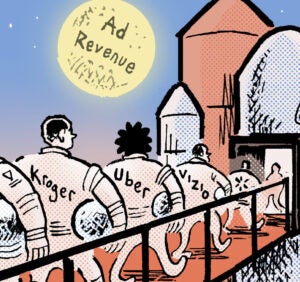
Airbnb gets one step closer to launching a retail media biz; Google shakes up its ad tech executive team; and streamers struggle to balance ad and subscriber revenues.

Google isn’t perfect. But it offers convenient, cost-effective advertising tools that millions of small businesses use to find customers, grow and succeed. If the DOJ breaks up the company, it will also break those tools.

It might be surprising to learn the government fights against monopolies the same way now as it did in the late 19th century – partly because the laws haven’t needed to change all that much.

In today’s newsletter: Pinterest launches an ad optimization solution with familiar-sounding name; consumers can’t live without YouTube; and ad tech leaders try out trade journalism.

In today’s newsletter United Airlines gets into retail media; why AI fails to catch AI-generated content; and political advertisers flock to X for cheap impressions.

In today’s newsletter: Roku and The Trade Desk expand their partnership; Instagram changes its content recommendation system; and the European Commission investigates Meta for potential Digital Services Act violations.

In today’s newsletter: The CMA still has a bone to pick with the Chrome Privacy Sandbox; the FCC fines mobile carriers for selling customer location data to data brokers; and the Financial Times is the latest publisher to strike a licensing deal with an AI company.

CEO Mark Zuckerberg cautioned that it will likely take years before Meta’s generative AI products, including Meta AI, are ready for monetization.

In today’s newsletter: Google AdSense publishers are in crisis; Apple is fighting antitrust suits in the UK and the US; and Sherwood Media has a post-SEO strategy.

Industry experts weigh in on Forbes’s MFA subdomain and why ad verification tools still regularly fail to flag some instances of alleged SIVT.

In today’s newsletter: Google’s ad strength meter could push advertisers to adopt Google’s campaign preferences; Home Depot hosts an “InFront” to show off its RMN, Orange Apron Media; and the Privacy Sandbox rollout could do serious damage to the online ad industry.

The vast majority of advertisers who buy ads in video games (91%) no longer consider gaming to be an experimental media channel. But ad spend in games still lags behind audience engagement.
In today’s newsletter: Performance Max has many imitators, but Google’s still ahead of the pack; France’s competition authority fines Google for using news content to train its Bard AI model without their knowledge of consent; and Apollo Global Management offers to acquire Paramount Global for $11 billion.

New contextual targeting tools use generative pre-trained transformers (GPTs) to analyze websites and and build contextual audience segments. The companies behind them believe that GPTs can address some of the problems that plague contextual targeting.

In today’s newsletter: Apple adopts the owned-and-operated model for its ad platform; the banality of click farming; and how consumers and businesses alike are getting squeezed on data storage costs.

In today’s newsletter: Microsoft Edge debuts its Ad Selection API, a PAAPI competitor; the EU’s DMA is live; and OhHello aims to help ad industry employees network.

In today’s newsletter: Big Tech may be best positioned to take advantage of generative AI’s ad tech uses; ad tech leaders waffle on investing in Chrome’s Privacy Sandbox; Google faces an innovator’s dilemma.

In today’s newsletter: Google agrees to placement-level reporting across its Google Search Partners network; how an explosion of ads is ruining the internet; and Google pays publishers to test an unreleased generative AI tool.

In today’s newsletter: Can Etsy and Wayfair compete against Temu?; audience data dominates the TV upfronts; the FTC sues to block the Kroger/Albertsons deal.

AdExchanger consulted with agencies about how they are evaluating new generative AI tools for marketing use cases as well as the tech companies behind these startups breaking new ground in generative AI.

When Google finally stopped supporting third-party cookies for 1% of Chrome users, the ad industry reacted as if the sky was falling. But it’s unlikely that Google’s cookie deprecation plans will ever be fully fulfilled.

In today’s newsletter: The New York Times is rolling out a generative AI ad product; the current state of adoption of Apple’s SKAdNetwork 4; Google seeks explicit consent for retargeting and personalization in the EU.

In today’s newsletter: could an open-source website template fix programmatic advertising?; The Trade Desk’s new tool for targeting only the top 500 sites; and some of Apple and Microsoft’s services won’t fall under DMA regulation.

The question isn’t whether Google will fall, but whether its time is near. And, if so, what will finally bring it down?

The anonymous alphanumeric string made and lost fortunes in its short but eventful life. It was best-known for something it wasn’t actually designed to do: targeting ads.

IPG struggled in 2023 as tech clients slashed their ad spend and its digital agencies underperformed.

While other holding companies are touting their AI roadmaps, Omnicom is focusing more on a different shiny object: retail and commerce media.

In today’s newsletter: The FTC is suing Kochava (again); marketers are complacent about third-party cookie deprecation; and Publicis Health pays the piper for its role in the opioid epidemic.

Danielle Coffey, CEO and president of the News/Media Alliance, believes journalism and generative AI can play nice. But first, gen-AI companies must get real about the value journalism brings to their products.

Last week, FTC Chair Lina Khan announced a probe into Big Tech’s relationship with generative AI companies at an FTC forum to address competition concerns related to AI technology – its first AI-focused tech summit.