

 “The Sell Sider” is a column written for the sell side of the digital media community.
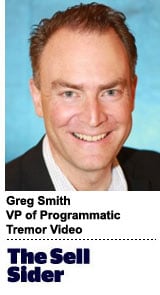
Today’s column is written by Greg Smith, vice president of programmatic at Tremor Video.
People say there’s not much premium video inventory available programmatically. That will change when buyers and sellers better understand their options.
There are two common misperceptions about programmatic buying and selling, particularly about video ads. The first: There is not much premium video inventory available programmatically today. The second: Publishers lack or should distrust other programmatic options.
Yes, it’s been true in the past that premium video publishers have resisted “cheapening” their inventory by making it available via RTB, a process many still see as the sum total of programmatic advertising.

But this is changing. The fact is, private marketplaces and other structured programmatic transactions offer multiple options well beyond open auctions and are becoming increasingly attractive to both publishers and buyers.
Finding Clarity In Terminology
One barrier to greater adoption: Many people are confused about the various types of programmatic transactions. Fortunately, the Interactive Advertising Bureau (IAB) has done an excellent job of defining three programmatic options beyond open auction that commonly use Deal ID, an emerging part of programmatic ad buying that matches buyers and sellers individually.
As defined by the IAB, these increasingly popular programmatic options include:
Automated guaranteed: This type of transaction most closely resembles a traditional insertion order, where the inventory and pricing are guaranteed, but the inventory typically runs through the marketer’s own demand-side platform (DSP) set up via a master service agreement contract. This transaction is often used when a buyer wants to secure hard-to-find inventory, but also wants to manage targeting and reporting through its DSP.
Unreserved fixed rate: Typically used by buyers looking for specific audience segments that need to sift through large quantities of impressions to find their “needle in a haystack” target customers. It offers buyers a right of first refusal at a fixed cost per mille before an impression goes to open auction. Accordingly, these transactions are typically priced at a premium compared with open-auction methods.
Invitation-only auction: This transaction is similar to an open auction, in that it uses RTB protocols but also allows publishers to restrict the number of advertisers that are allowed to bid. In some cases, publishers may provide more detailed information about their inventory to those advertisers.
It all seems clear enough but some have taken liberties with their names. For example, the automated guaranteed method is sometimes referred to as “programmatic guaranteed” or “programmatic premium.” Unreserved fixed-rate transactions are sometimes called “preferred deals,” “private access” or “first look.” Invitation-only auctions also go by a variety of overlapping terms, including “private auction,” “private access” or “closed auction.”
This sometimes leads people to just nod their heads while not really understanding what they’re talking about. Since some people don’t understand the terms, opportunities have been missed.
Overcoming The Drag On Publisher Mindsets
This confusion also has caused a drag on publishers’ understanding of their options beyond open auctions. As everyone comes to understand and use the same terminology, things will move faster. Meanwhile, agencies that are well aware of their clients’ positive view of the tracking and analytical value of private marketplaces will increasingly make known their clients’ needs and their own buying clout. This also will influence the hearts and minds of premium publishers.
Open auctions will continue to grow as a programmatic option because of the value of volume, as well as its low cost to the buyer. But the growth of non-open auction transactions – structured programmatic transactions, as defined above – will be far greater.
The full three-page IAB document, called “Programmatic and Automation – The Publishers’ Perspective,” explains these transaction options in greater detail. I highly recommend reading it and learning the IAB programmatic transaction vernacular. Consider it a New Year’s resolution of sorts. By speaking the same language, we can all move our industry ahead with greater speed and accuracy.
Follow Greg Smith (@webadsguy), Tremor Video (@TremorVideo) and AdExchanger (@adexchanger) on Twitter.







