

 Early Wednesday morning, a week after the initial US launch of Pokémon Go, a small milling crowd formed outside Barney Greengrass, an iconic Upper West Side Jewish deli and a “PokéStop” – a real-world location anchored in the augmented reality game interface.
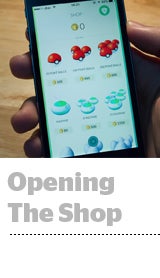
It’s not unusual for queues to form for bagels and smoked fish, but there’s little doubt about what interested this crowd. The game has a lure item that attracts Pokémon to a PokéStop for 30 minutes.
In one uptown Petco, employees aren’t allowed to use apps during work, but a PokéStop located on premises was constantly activating lures.
“Normally we tell people, ‘come back in 30 minutes,’ and they leave,” said one of the store’s groomers, who requested anonymity, pointing to a small group on their phones waiting to pick up a clean pet.
Within 24 hours of its launch last ,Wednesday Pokémon Go was the most downloaded and highest-grossing app in the App Store. While brands and retailers note that the game is a powerful traffic driver, they’re not always sure if it’s doing more.
The actual consumer impacts are difficult to quantify (there is no paid media to measure, after all), but the effect is apparent to just about anyone who relies on foot traffic.

Central Park can’t monetize Pokémon Go in any direct sense, but mobile food and beverage vendors will redeploy next to uncovered PokéStops for the summer, said one park employee.
For others, it can be difficult to distinguish if Pokémon Go has increased visitors.
“It’s actually hard to tell if there’s been an increase as a result of the game,” said a spokesperson for the New York Public Library, which published a blog post directing users to in-library PokéStops and is using social media to promote Pokémon captured by visitors.
“Because our institution is free and it’s always crowded, it’s really hard to tell,” she said.
There’s also an element of luck and whimsy to Pokémon Go’s real-world impact that doesn’t neatly fit with the data-driven marketing ecosystem. In order to have a really strong brand application, a real-world location needs to feature a PokéStop, which tend to be attached to civic or religious centers: public art, registered landmarks, statues and monuments or architectural frontispieces.
The Petco happens to have a mural commissioned years ago by a city arts project painted on its side, and it is thus endowed with a PokéStop.
But businesses actively measuring the impact of Pokémon Go do claim to see results. An owner of more than 10 franchises for a commercial coffee chain said about half of his locations have a PokéStops in their geo-range. “We’ll be measuring the difference in foot traffic at certain times between those with lures [aka PokéStops] and those without,” he said.
The low cost of activating a lure – just $5 or less per store per day – makes it a worthwhile marketing investment: “I can tell you already though that at the locations where we have been keeping lures open all day, it’s the best ROI we’ve ever spent on marketing.”
In a world where marketers increasingly pay for provable results and not a dollar more or less, it’s rare to see major impact driven by sheer dumb luck.
Aaron Werner, coordinator of the Main Street Program for the city of McKinney, Texas, said that, “Since it’s a historic district, with lots of landmarks and statues registered, there are three gyms and tons of stops in this one little section.”
More than 50 business owners from the town’s commercial stretch showed up to a meeting earlier this week to discuss collaborative marketing initiatives for the summer, which ended up being a referendum on best practices for Pokémon Go marketing.
“A bar has had a lot of success promoting Twitter and Facebook pictures of Pokémon on the counters, and one convenience store just did a round of ads pitching itself as ‘official drink store for pokequesters,’” said Werner.
Businesses without convenient PokéStops have taken to offering discounts to anyone who activates “incense” (an item that draws Pokémon to an individual user) or uses social media to show Pokémon in their location, on the theory that bringing in either people or Pokémon will attract the other.
It’s easy to laugh off Pokémon Go as a summer fad or just the newest in a rotating cast of free app store games, but there are real metrics to support the marketing fervor to engage Pokémon’s audience.
For one thing, Pokémon leapfrogging mobile game incumbents overnight is no small feat. Supercell’s Clash of Clans, previously the only app to be the most downloaded and highest grossing, secured its position after months of prolific advertising, including a pricey Super Bowl spot. Pokémon practically tripped into first place without spending on ads and despite having server and functionality issues reminiscent of a beta test (oh, and it’s also only available in three countries: Australia, New Zealand and the United States).
Pokémon Go’s engagement stats, the premium currency in the mobile world, are downright frightening. According to data from the app store analytics firm Sensor Tower, Pokémon Go users spend more than 33 minutes per day head-down in the app. Facebook’s 22 minutes was formerly the high bar (followed by Snapchat, Twitter and Instagram, ranging between 15 and 18 minutes).
Pokémon Go’s numbers may come down, but a 50% drop in engagement would still leave it with one of the most active mobile audiences on the planet.
And Pokémon paid media doesn’t exist yet, but it is coming down the line. John Hanke, CEO of Niantic, the studio behind Pokémon Go and a former Google internal lab that’s now co-owned by Google and Nintendo (which in turn owns a third of the Pokémon franchise), said in an interview with the Financial Times that the company is developing “this concept of sponsored locations,” where establishments could pay to be featured in the game.
Hanke said the model would be similar to Google, but with charges on a “cost per visit” basis instead of Google’s cost per click. “The premise being that it is an inducement that drives foot traffic.”







