

 Augmented reality seems to have hit its mainstream stride with the runaway popularity of Pokémon Go, and users are having a blast – but location-based marketers are also getting pretty stoked.
“This is like the best high-profile marketing campaign for location intelligence that anyone could ask for,” said Foursquare president Steven Rosenblatt.
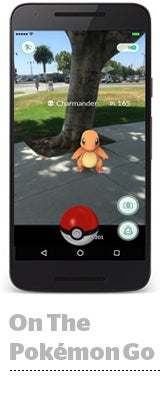
For those living under a rock (type): Pokémon Go is an augmented reality game created by Nintendo and San Francisco-–based developer Niantic that uses a smartphone’s camera to overlay Pokémon creatures like Pikachu and Squirtle onto real-world scenes. Users can then catch the Pokémon and train them for battle.
People are so besotted with the game – it’s been downloaded more than 7.5 million times in the US in less than a week – that they’re walking into trees and getting tangled up in revolving doors.
The app is GPS-enabled, which means users are required to turn on location services if they want to play the game.
And that’s where it gets interesting, said David Staas, president of NinthDecimal. (Or problematic, if you ask Al Franken, the Democratic senator from Minnesota, who wrote a stern letter to Niantic CEO John Hanke on Tuesday in which he expressed his concern that the company might be “unnecessarily collecting, using and sharing” user data, including location, without the proper consent.)
“You, of course, need to make sure people are clear on what they’re signing up for and what kind of information they’re sharing,” Staas said. “But to me, this is the next step in the evolution of the digital and physical worlds coming together – and consumers are loving when that combination happens.”

People are having fun, businesses are looking for a way in and there’s a whole new set of terminology for CMOs to struggle with around the conference room table.
PokéStops are blue markers that appear on the game’s map to denote that there’s loot or power-ups to collect there. Lure modules are placed on PokéStops to draw people to the location. Users can also buy in-game incense to attract nearby Pokémon creatures with a “mysterious fragrance.” Gyms are places where teams can do battle against each other with their respective Pokémon.
Yeah. Anyway, brick-and-mortar retailers can also use these in-app tools to beckon Pokémon – and users – to a given location. From there, it’s a short mental leap to location-based promotions and campaigns.
“Connecting in-game actions to offline behaviors to optimize gameplay would likely be the first-use case with this data asset,” said David Shim, CEO of Placed, who joked that he’s been playing the game “purely for location research purposes.” He’s up to level 10 trainer status.
“Using location analytics, Nintendo and Niantic can determine the optimal distance between PokéStops and gyms to maximize gameplay,” said Shim.
And, it stands to reason, to connect in-store activity to gameplay or a lure-related campaign. Entice users to a coffee shop with the promise of a Pokémon to catch and a discount to redeem, and there’s the opportunity to tie foot traffic back to the game. Voilà: attribution.
It’s all speculation right now, but the anecdotal evidence is there, said Yext CMO Jeffrey Rohrs.
“We’ve certainly seen a lot of quick-witted restaurants throw up signs welcoming Pokémon Go players in for a drink, meal or rest, [and] in the future, I have to believe we’ll see Pokémon Go work with sponsors to incentivize visits and track performance,” Rohrs said. “To put it another way, imagine the sales spike from Pokémon Go players if you could only get a rare Pokémon at your local McDonald’s via a purchase code received in store.”
First-party intent signals are also quite valuable, said Foursquare’s Rosenblatt. That’s also what makes search data so rich.
“Pokémon Go hit a chord with people – they love discovering things in the real world, and if you’re a marketer that can get access to that type of data, it’s massively powerful,” he said. “Wherever there is intent, there’s an opportunity to understand consumer behavior.”
 But if Rosenblatt were being called in to consult on Pokémon Go’s theoretical ads business, the question he’d ask is: “Yes, they’re collecting a lot of data, but are they understanding who these people are?”
“Pokémon would need to understand consumer behavior beyond the fact that people are addicted to playing the game right now – they’d need to know what else they’re doing when they’re out in the physical world,” he said. “They would also need to figure out real-world rewards for consumers who walk into a store rather than just points in the game.”
If Nintendo has any intention of appealing to advertisers, it would also need to think about developing its own measurement dashboard or partnering with a third party, said Staas, noting that the game company ”would need to provide services to make this really compelling, especially over a longer term.”
But the lack of those things is unlikely to stop brands from wanting to experiment, at least at first.
“Doing something innovative involves taking a risk,” Rosenblatt said. “If you’re a marketer, you’re going to place a few bets, and you’re not necessarily going to be thinking about measurement until whatever you’re experimenting with starts to take off.”
Regardless, it’s unlikely that Nintendo and Niantic will introduce in-game advertising in the near future, especially with recent estimates projecting that they’re making nearly $2 million a day on in-app purchases, Shim said.
What’s more likely are low-hanging fruit ad campaigns that drive foot traffic to the Pokémon Go demographic using lures.
“I see the asset as the Niantic platform as much as the location data,” Rohrs said. “Looking at Pokémon Go, I can easily see a future where Niantic opens its map and limited data sets to developers to create their own spin-off experiences” – everything from schools helping students to collect info about historical monuments to virtual tours in TripAdvisor.
Essentially, nothing that Nintendo and Niantic could do with location data is anything that isn’t already either possible or being attempted today, including tracking user location, creating audiences based on user activity, targeting, powering timely notifications and connecting online and offline experiences.
It’s just a question of opportunity and not mucking it up.
“The future could take Pokémon Go in any number of directions that would create new opportunities for marketers to engage consumers,” Rohrs said. “However, as we have learned with every digital channel, the consumer is ultimately in control, and the marketer must tailor their approach to the environment, not vice versa.”








