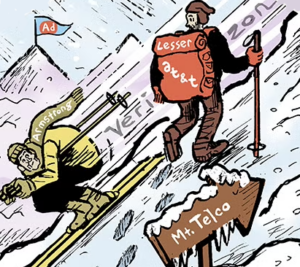
The Wall Street Journal’s revelation Friday that Tim Armstrong, leader of Verizon’s Oath media and advertising group, is in talks to depart the company is in stark contrast with the elevation of media and advertising at its biggest competitor AT&T.
When Verizon first assembled Oath, many industry insiders wondered if it would create a new media giant, powered by Verizon subscriber data, that would compete with Google and Facebook for addressable ad dollars.
AT&T, which is still developing its ad group and which owns WarnerMedia, seems to be inheriting that mantle. Meanwhile the industry is still wondering when Oath will integrate its AOL and Yahoo ad tech assets. And Verizon’s video content portal Go90 already tanked, leaving in its wake a $658 million write-down.
The idea of tapping Verizon data for advertising seems like a dream from yesteryear.
“It’s tempting to simply see AT&T and Verizon as approaching the old-media/new-media convergence point from opposite directions: Verizon betting on digital media and AT&T going all in on the future of TV,” said Gartner VP Andrew Frank. “But both approaches seem more or less based on a classical walled garden strategy of combining proprietary media assets with a scalable targeted ad platform, a position that’s currently occupied by Facebook, Google, and, increasingly, Amazon.”
One of the biggest differences between the two telcos is that advertising has been a top-level priority for AT&T.
First, the $9 billion Verizon spent on AOL and Yahoo properties pales in comparison to AT&T’s $85 billion deal for Time Warner and $2 billion follow-up for AppNexus.

And CEO Randall Stephenson has been a vocal backer of the advanced ad group and repeatedly refers to it as critical for his vision of a “truly modern media company” combining telco networks, content and data-driven advertising.
And part of being a “modern media company” is developing direct-to-consumer relationships.
That philosophy explains the elevation of Brian Lesser, who leads the AT&T’s advertising and analytics division and reports directly to Stephenson. Lesser spoke at length with investors during the company’s earnings report in July.
Oath gets relatively less notice as a subsidiary, and has often been reported separately in quarterly earnings because of its long integration process and write-downs.
And while Lesser has a champion in Stephenson, it’s unclear if Armstrong has a direct line to new Verizon CEO Hans Vestberg, who took over after previous chief Lowell McAdam retired.
And even when McAdam was around, Armstrong wasn’t his direct report. Marni Walden, Verizon’s former EVP and president of global media, who spearheaded the acquisitions of AOL and Yahoo, oversaw Armstrong. And she left at the end of last year in part because of her frustration not being elevated within the company.
AT&T’s embrace of high-quality content and advertising stems from anxiety amid the rise of Google, Facebook and Netflix. It’s betting on owning content across all channels including linear – and using better advertising to help subsidize that content.
Verizon on the other hand seems focused on its pipes and making sure people are using them – hence its squeamishness allowing subscriber data to seep into Oath’s ad tech. Video for instance is the major driver of traffic on Verizon’s mobile and internet network, said former CEO McAdam on the company’s last earnings report.
“But we’re not fans of linear,” McAdam said. “I’m not trying to criticize anybody else’s strategy here, it’s just the fact of the assets that we have and the investments that we want to make.”