

 In the four months since Verizon’s acquisition of AOL closed, AOL absorbed Microsoft’s advertising business, dropped $238 million on Millennial Media and Verizon revised its privacy policy in anticipation of its data flowing into the AOL stack.
Since AOL launched a unified platform called ONE, it has preached the gospel of “openness.” But will that standard hold once Verizon’s subscriber data sets are activated?
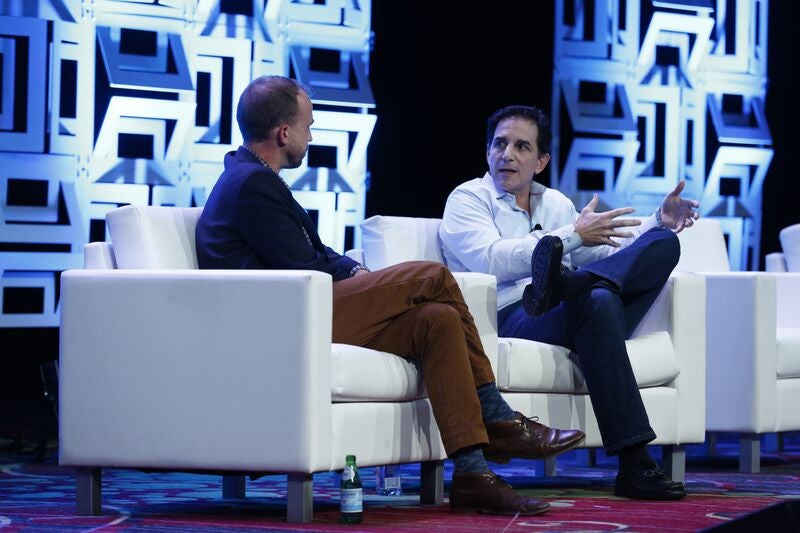
Bob Lord, president of AOL, sat down with AdExchanger’s Zach Rodgers for a fireside chat at AdExchanger’s Programmatic.io conference in New York Thursday.
Below is a summary of some of the salient points.
AOL still claims openness.
When AOL acquired Convertro and built out multitouch attribution and its own data management platform (DMP), clients wondered they would still be able to integrate their own DMPs. AOL said they would.
Lord said AOL’s stack remains as an open ecosystem and clients don’t have to buy all of AOL ONE’s platform in order to access individual components. “We have one unified campaign manager and planning tool across mobile, display and video,” he said, calling one of AOL’s strengths its reporting capability. AOL wants to help marketers figure out if money spent attained their objectives.
Walled garden be gone?
AOL is sticking with its commitment to open data, for now. One problem with large incumbent platforms, according to the buy side, is that it’s hard to extract meaningful user-level data for measurement and attribution.

“There are three aspects of data we have to be careful about: collection, access and usage of the data,” reiterated Lord. “I’m now saying publicly as a brand, you own the data we commingle as long as we agree to the controls and usage of the data. We need to be careful about consumer protection, and ensure it’s opt-in, and no PII. … opt-ins for Go90 [AOL’s new video content network] are great and we’ll use that as a baseline for which we can extrapolate out.”
Verizon/AOL says it has a cross-device differentiator.
Even if all Verizon users opted in to allow tracking, that’s only about 30% of the US market. What will it do to improve cross-device accuracy? “The fact that we have a large base where we can get really specific and then apply algorithms to extend that reach, positions us well,” Lord said. “You’re going to have to spend on Google, Facebook, AOL if you’re a marketer. …Verizon has a lot of apps in its own right and you start to see the power the mobile carrier brings [around developers/SDKs] in new endeavors.”
 AOL remains acquisitive.
Adap.tv. Vidible. Precision Demand. Millennial. AOL’s been aggressive with video and mobile acquisitions, but does it have all of the tech it wants on the sell side? “There could be niche tools we add around yield management activities,” said Lord. Tools that partner well with Convertro and enable multi-touch attribution, are also of interest. The goal, he said, is applying programmatic tools on the publisher side.
Verizon-AOL’s not prioritizing the ad tech over the media.
When Verizon acquired AOL, one looming question was whether the deal was media or tech motivated. (And would Verizon retain AOL’s more popular digital pubs like The Huffington Post and TechCrunch?) Fast forward to AOL’s absorption of Microsoft’s ads business, and the answer begins to crystallize. “You need to be able to talk to a CMO about how a campaign for Xbox works with a buy on the Huffington Post,” Lord said. “We’re going toward branded entertainment … [and] the second piece of that is technology.”
Microsoft is AOL’s inroad into other countries.
“Microsoft is talented in countries AOL isn’t in.” As such, AOL sees the path for global expansion via its Microsoft deal. Now that AOL can access display, mobile and video inventory across Microsoft’s nine largest global markets, what would happen to AppNexus, Microsoft’s platform partner?
“If you’re buying programmatic in those nine markets, you’re buying through AOL,” Lord said. “We’re working with AppNexus there (to support Microsoft). We want to allow media buyers to have options.”
But are AOL’s field sellers the Trojan horse for its platform?
“Yes, definitely.”
Here’s the full video:
Edited for clarity and length.







