
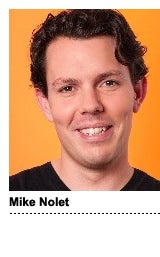
 Mike Nolet has stepped down from AppNexus, where he has served as CTO since the company’s founding six years ago. He will remain an advisor but vacate his board seat, which will be filled by President Michael Rubenstein.
Nolet is a foundational character in the programmatic story, having helped build the world’s first ad exchange when he was product manager of Right Media in 2005.
In an interview, he said his decision was motivated by an entrepreneurial urge and described plans to launch a business (not related to ads) with his wife Stephanie. He said AppNexus is in great standing. “Companies regularly outgrow their founders,” he said. “There’s nothing worse than that lame duck CTO who doesn’t do anything.”
Nolet’s exit does not come as a surprise. For the better part of this year he has appeared steadily less involved in the day-to-day operations at AppNexus. He moved to London seven months ago, and this summer the company promoted SVP Engineering Igor Shindel to chief information officer. At the time a company rep said Nolet’s role was focused on clients and product plans, while Shindel would oversee technology strategy, operations and hiring. But the writing was on the wall.
Nolet spoke with AdExchanger about the next chapter for himself and AppNexus.
What about this moment made it right to move on?
The company is doing fantastically well. I’m excited to step off the field full-time now and move into an advisory role. We just closed our Series D earlier this year, and the company has such a fantastic leadership team. Companies regularly outgrow their founders. There’s nothing worse than that lame-duck CTO who doesn’t do anything. I love everybody here, truly and deeply.

Did the prospect of an IPO have anything to do with you leaving?
No. Nothing to do with IPO. I went through the Yahoo acquisition at Right Media. It’s more wanting to get back to getting my hands dirty. At some point, leading a large organization is not the same skill set as founding a company.
I want to move full-time into other stuff.
What can you say about what you plan to build with your wife?
I don’t really know yet. One thing I learned at AppNexus is what you really want to focus on is not a specific idea. Startups are not successful based on an idea. They’re successful based on their ability to understand space, understand a problem set and build against that. It’s an iterative process.
We’re going to go understand a space and understand problems, and build something for it. And hopefully we’re successful.
But not in advertising?
Not in advertising, no.
How does AppNexus meet the social and mobile challenges?
Mobile is a key challenge for us this year, and our goal is to add capabilities, so that everything we do in display we can do in mobile. So many companies are starting from scratch, and if you look at the advertising layer, the mobile technology stack is not that different from the display stack. Yes, there’s a different device. Yes, there are challenges with ID matching. But, broadly, mobile is far more similar to display than it is different. That puts AppNexus in a really good spot.
The other good thing, you look at what Facebook has been doing with FBX, it’s been great for the industry. And Twitter getting into that game as well is only good for us. The core technology, the core decisioning, the core targeting, most of that is the same – whether it’s Twitter, Facebook, mobile or display. Really, it’s just display ads across different devices. I think next year people will start talking about display advertising [as a cross-device format], and maybe five years from now we’ll laugh at the fact that it was mobile vs. desktop.
Any thoughts on the word “programmatic” and what it stands for? Does it just fade into the background as it comes to define how all media is bought, and how long before that happens?
I’ve been doing this for nine years. It took that long for programmatic to take over the remnant “Class 2” space. Everyone pretty much expects that Class 2 is going programmatic. It’s almost certain that the premium-direct sold inventory will go through more automation. I think it’ll go faster but I still think it’ll take a long time. I wouldn’t be surprised if it takes five years before we start saying that everything is programmatic. It takes a lot of time and a lot of companies to change a lot of business process to adopt new technologies.
Do you aspire to keep a hand in ad tech from an investment standpoint – whether that’s angel investing or sitting on boards?
I have a lot of people that I care a lot about in the ad-tech industry. I’ve had informal advisory relationships for my entire career, and absolutely these are people I’m going to keep hanging out with and working with. And, broadly, I just love startups and entrepreneurs.








