

 Acxiom’s $310 million acquisition of data onboarding company LiveRamp, expected to close this summer, will raise significant questions among LiveRamp’s clients, many of whom are Acxiom’s competitors.
As if predicting these concerns, the companies have gone out of their way to emphasize LiveRamp’s continued openness and neutrality. Acxiom CEO Scott Howe reiterated this message during his company’s earnings call Wednesday, stating that the day has arrived when Acxiom competitors become Acxiom clients.
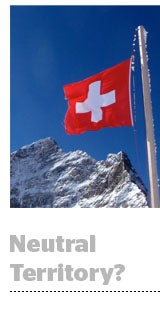
“There’s a need for someone to perform the role of Switzerland in the world and be the neutral, agnostic power grid that everybody can plug into,” Howe later told AdExchanger. “By virtue of having that kind of public utility, everybody in the industry wins and the pace of innovation in the industry took a huge leap forward today.”
AdExchanger spoke with Howe and LiveRamp CEO Auren Hoffman, who will continue on with the company.

AdExchanger: Though you say Acxiom is Switzerland, it really isn’t, even though LiveRamp had been.
SCOTT HOWE: Auren should jump in since he’s had the conversations with his clients on this. But I’ve lived this before. I’ve seen this movie and I know how it ends. I was at Atlas when we decided to license our technology to all of Razorfish’s competitors. And it was a good thing for the industry.
Does it mean our team at Acxiom needs to be as maniacally focused about serving their own direct clients today? Do we need other teams of people that are as maniacally focused about ensuring that some of our competitors and partners are successful? Absolutely. Here’s the good news: When you talk to Auren’s team, they’re almost religious with their fervor around that. They’re saying, “You’re not going to cause me to do anything different because my client is Epsilon.”
My response to them is, “Of course not!”
The message to Epsilon should be they’re going to get better service as a result of this. Because all of the sudden, LiveRamp will be able to expand internationally faster, they’ll have more investment into their products. I think this should be really good. I don’t think it’s threatening at all for the industry.
AUREN HOFFMAN: One of the reasons we decided to go with Acxiom was because of their commitment keeping LiveRamp as a neutral and open system. We’re excited Acxiom is behind that vision and we share that vision. We’ll be able to serve our current customers and our future customers even better in the future by leveraging the assets Acxiom has.
There’s still the market reality of people being uncomfortable with a system like yours existing anywhere other than as a neutral system.
HOWE: Here’s the thing. First, it was in ad serving. Then it was who’s going to create the neutral display ad exchange. The people who said they were going to do those things in some cases didn’t follow through. The supposedly neutral ad exchange lists their own inventory first. Or the supposedly neutral search provider lists their own properties higher.
It’s all a matter of philosophy, culture and policy. What you hear is the two most senior people in this organization saying, “This isn’t going to play. We won’t allow it.” We’re telling the world we’ll be open and neutral and if it requires we get an auditor in here every year to confirm that we’re living up to our policies, we’ll do that.
That’s something I’ve thought about. I want to accredit this such that the entire world has confidence in what we’re saying.
Auren, you spoke with LiveRamp clients who are also Acxiom competitors. What was your messaging and how has that message been received?
HOFFMAN: First, our commitment this remains an open and neutral system for everyone to use. That won’t change. The only difference is we’re going to have a lot more capabilities. We’re going to be leveraging Acxiom to help us go international. That was something every single one of our customers has asked of us and we haven’t had the capability to do that.
Will you combine Acxiom Audience Operating System and LiveRamp or will LiveRamp continue to live on as its own brand and as its own product?
HOWE: To be determined. I think there’s some impact of the Acxiom brand in terms of security and privacy and international reputation. That’s one of a million things we have to think through over the next few months, once this deal is approved and we go forward.
More importantly, we’ll continue to operate LiveRamp as an autonomous entity. They‘ll keep their office in San Francisco. The first thing Auren and I will do is shop for a bigger office in San Francisco because they’re running out of space and plan to hire very aggressively.
What we need them to do more than anything else is keep doing what they’re doing, but faster and at an international scale. The last thing we want to do is a weird, complicated, bureaucratic integration. Those never work. We want entrepreneurs to be entrepreneurial.
Even before the acquisition, Acxiom had worked with LiveRamp. What does its technology enable?
HOWE: When I think of LiveRamp, there are three things they do incredibly well. The first is data onboarding. It became apparent to us with our own clients in AOS is after they signed up, there was this long holding (period) where they were saying, “Here’s my data. Let me get up and running.” And it was just too slow. Auren’s team has perfected the technology and processes behind data onboarding. That will allow our clients to get up and running faster.
The second thing they do really well is matching, taking an insight from one channel and utilizing it in other channels as well.
The third piece is the whole concept of data distribution. Once you have an insight and know you want to message someone, how do you transfer that data and insights to other partners in the ecosystem, like publishers or application providers?
Joanna O’Connell contributed.









