
By Kelly Liyakasa and James Hercher
Criteo’s $250 million, all-cash purchase of retail exchange HookLogic on Tuesday was premeditated.
Meaning, the two companies already knew of the other’s capabilities – and a marriage felt right for the future of both ecommerce ad tech companies, said Criteo CEO Eric Eichmann.
“We’d been talking to HookLogic for almost two years looking for potential linkups, and it just became clear there’d be more value if we worked directly together than if we just structured a partnership,” he told AdExchanger after the deal was announced.
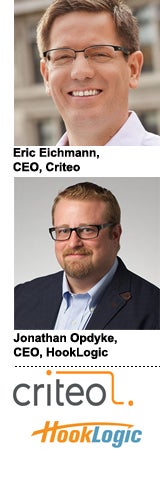
In separate interviews, Eichmann and HookLogic CEO Jonathan Opdyke spoke with AdExchanger about the rationale and benefits of their deal.
AdExchanger: Does the HookLogic acquisition change Criteo’s market positioning?
ERIC EICHMANN: There are lots of synergies around the deal and reasons for us to link up with HookLogic, purely from the perspective of growing their business. HookLogic is a very network effect-driven business. The first thing for us was helping HookLogic expand their business and scale it up. We have 9,000 retailers we work with and they have 50, and then there are all the publishers we can drive toward the HookLogic Exchange.
What about from a technology perspective?
EICHMANN: We can use our engine to drive better performance of their exchange, and we’ve gone through the problems any company has gone through when they internationalize and scale a platform globally. From a Criteo perspective, it starts changing and becomes more of what we’ve been talking about all along, which is becoming a real performance platform that incorporates a number of publishers and advertisers.

For HookLogic, what were some of the synergies that made this an attractive deal?
JONATHAN OPDYKE: From a big-picture perspective, Criteo’s business is primarily with retailers, and HookLogic works primarily with the manufacturers who sell through those retailers. So it’s two sides of the same coin. There’s also synergy in the sense that Criteo ads are mainly off of the retailer’s site [retargeting ecommerce opportunities in non-ecommerce environments], whereas HookLogic ads have focused on the retailer’s own site. Criteo charges the retailer, and HookLogic pays the retailer. Being in a position now to pay retailers – that’s a win for Criteo.
And there are other common goals we’ve both been working toward. They expand their advertising base, but as a massive optimization engine for performance marketing, there are shared goals, like offline attribution and device matching, [that] we get much closer to together.
Was the deal motivated by competitive movement, such as Amazon’s development of a DSP with direct integration into its header bidding setup?
EICHMANN: This will position us as a company that can bring new solutions to advertisers. We’ve talked about search in the past, and this is a very retail-centric solution that helps them drive much more performance out of their search spend. In two to three years, we’ll have a number of products that help retailers compete against the Amazons and Alibabas of the world. We’re creating a number of solutions for advertisers to compete with Amazon without having the technology investment Amazon has. It becomes a more powerful story than being a one-product company.
How so?
EICHMANN: Retailers are suffering competing with Amazon, which has scale, a marketplace, advertising revenue, an incredible amount of data and a device graph. We, through our pooled asset, give a device graph to retailers freely if they participate in the program. Our job is to help retailers use their data to drive sales through their site better through any mechanism they can use. Now, with HookLogic, we can come to them and say, “In addition to driving people to your site to drive sales, we can also drive advertising to your site.” That’s been one of the benefits Amazon has had over their retail counterparts.
Were there any macro factors that played a role in the deal getting done now? Was having it done in time for Q4 a motivating factor?
OPDYKE: There’s obviously a lot of activity happening in the ad tech sector right now. A lot of players are looking to make moves. But if there’s a macro factor driving our value prop, it’s that scale is the key to the future. Scale is what will enable you to compete or not. We didn’t want to be in a deal cycle on Black Friday so we got it done now, but that wasn’t why we started discussions.
I look at the space as providing clients the ability to compete on equal terms with Amazon. Our network effects are strong already, but the more we can create network effects the more we can demonstrate value to our retailers and brands.
What does HookLogic add from a demand perspective?
EICHMANN: One thing this opens up on the demand side is the ability to work with more brand manufacturers, and not just with the HookLogic business. We can go to retailers with a search product where you can take brand manufacturer bids for their products and enhance the bids from the retailers they’re already running with on Google search and make that a much more powerful offering and drive a lot more traffic and ultimately sales to them. Over time, we don’t just want to serve retailers, but anybody in an ecommerce environment that’s looking for performance marketing. Brand manufacturers are logical extensions of that.
How are you differentiated?
EICHMANN: We’re a powerful buyer of inventory across the world, but over time we think we’ll have a very differentiated offering that will allow us to do things that will be very hard to do for manufacturers and retailers without a pooled asset [cross-device] because they’re not big enough to capture the whole world. Then you have people like Facebook, which, while terrific and a partner of ours, has a device graph that sits well within its world but doesn’t translate well onto the open web. We want to be the missing link.
Was there any client overlap with HookLogic?
EICHMANN: There were some very large retailers we were not working with. As a retargeting solution, we’re still a small part of what the retailer’s thinking about. Adding HookLogic, which has very strong relationships where they are paying money to these retailers, opens doors to talk about the device graph and our search, data and pooled technology assets that can help drive business. It opens doors to brand manufacturers or retailers who in the past didn’t have a reason to talk to us.
What does this deal mean for current HookLogic advertisers?
OPDYKE: It’s business as usual for the time being. The deal hasn’t closed yet so no immediate change, but we’re entering Q4 when a lot of our business gets done, so we have to keep executing. The synergies will really start next year and accrue over a couple years.
What I can say, particularly for our big global advertisers, is that providing a single solution they can use to elevate themselves around the world is a big deal. The faster we can get global, the bigger our value prop is for big retailers and manufacturers. I can’t promise on the tech and product front what will be done, because we don’t know exactly yet, but global expansion is one clear value we can bring to clients quickly.
Does Criteo remain acquisitive?
EICHMANN: We had a line of credit and still have $350 million in the bank. We’re not going to spend all of our money. The limitation has not been the means to buy, but finding businesses that have good technology and are sustainable over time, as opposed to a lot of businesses you see. If there are companies that reinforce the world’s performance marketing platform we’re building, we’ll go after them.
These interviews have been condensed and edited.







