

 Just weeks after acquiring HookLogic for $250 million in an all-cash deal, Criteo is pushing into paid search.
Criteo played primarily in performance display until now, but its Predictive Search product marks its first major move into a different part of the marketing funnel.
It’s a $33.2 billion market that’s dominated by Google, whose Shopping Ads (formerly Product Listing Ads) make up more than half of retail marketers’ search budgets in the US. Criteo is already a big Dynamic Product Ads partner to Facebook, but says Google Shopping Ads are a growing area of client demand.
Criteo worked on the Predictive Search technology for more than a year after its 2015 acquisition of DataPop, an LA-based company that turns retailers’ product catalogs into paid search ads on Google, Bing and more.
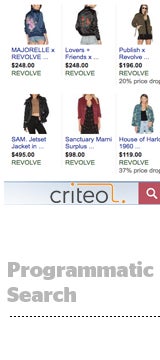
About 30 brands, including floral delivery service Teleflora and LA ecommerce brand Revolve Clothing, are testing Predictive Search.
Teleflora needed a partner who could help it stay on top of Google Shopping Ads specifications and manage a product catalog of hundreds, if not thousands of SKUs, according to David Gottesman, director of digital marketing for Teleflora.
In Teleflora’s case, it’s hard to win on price because flowers are more or less a commoditized purchase. (Meaning, it’s hard to differentiate between a rose that came from Teleflora or one from 1-800-Flowers.)

But Criteo has helped the brand manage high volumes of bids – 50-60% of business happens occurs during three high-volume holidays, including Valentine’s Day and Mother’s Day. Telefora could also enter its goals automatically and bid up or down more effectively by factoring in seasonality.
Revolve Clothing also managed paid search in-house but it was a “cumbersome task” so those responsibilities were outsourced to DataPop before its acquisition, said Ben Shum, search engine marketing manager, for Revolve and its luxury brand subset, FWRD.
“We had worked with a third party for bidding, but didn’t feel they took into account that text ads and PLAs require extremely different strategies,” he said. “Using DataPop and Criteo, we were able to get some quick wins just by making changes to our category-level titles and descriptions.”
Criteo claims its emphasis on performance and its ability to consistently outperform competitors due to direct publisher relationships also applies to Predictive Search.
“When people type in the word ‘dress,’ they’re not bottom of the funnel,” said Jason Lehmbeck, the GM of search at Criteo, and former co-founder and CEO of DataPop. “They’re in this discovery phase, so for us, prospecting is interesting and we’re looking at doing that in a programmatic way to match the right user to the right product at the right price based on our engine.”
Criteo thinks there’s more opportunity to combine intel from search with other data sets. For instance, it may one day tap sponsored product data from HookLogic when a marketer identifies a consumer at the brand or category level.
Or, with the evolution of Google Shopping Ads to include email matching, marketers can alter their ad creative based on CRM data around product preference, past purchase history and price.
“You can argue Carousel ads [product ads in Google search results] are more of a CRM feature,” Lehmbeck said. “Where, if you’re a loyal Teleflora customer and it’s a special occasion, maybe that would help determine whether or not you get free shipping.”
Predictive Search aims to tie these kinds of CRM-based insights to programmatic bids, allowing a marketer to re-engage a high-value customer or set bid parameters based on a user’s likelihood to purchase.
The Predictive Search product is generally available in the US as of Tuesday, and will begin rolling out globally in 2017.
Correction: DataPop was headquartered in LA, not Paris, as the article originally stated.







