

 Facebook’s menu of ad types is growing longer all the time. And as the company continually tests new formats, it’s getting harder to keep track of all of them.
Below is AdExchanger’s attempt to provide a snapshot of all relevant and current paid media products the company has on offer, along with a few that are still in experimental or beta phase.
Right Sidebar Ads
The worker bee of Facebook advertising, created using Facebook’s self-serve ad interface, or Ads API.
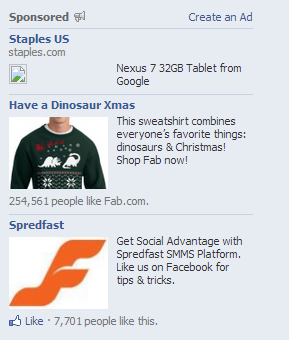 Creative consists of a 25 character headline, 90 characters of text and a 100×72 pixel image. Targeting is based on Facebook’s user data including demographic, geographic, interest and user-action (such as liking or sharing a Page or piece of content). Advertisers have control over pricing and optimization by bidding on a CPC or CPM basis, and can set a budget for the ad and time frame for the ad to run. Among the landing page options are external URLs, Facebook URLs, Facebook Pages, Applications, and Places.

Additionally, ad buyers can now upload and match their own database of existing phone and email contacts to Facebook users through the Custom Audiences option in the Facebook Power Editor.
Facebook Exchange
Facebook Exchange (FBX) is a real-time bidding (RTB) marketplace for Facebook inventory. It lets advertisers buy specific ad impressions based on users’ activity on outside websites, and is most frequently used for retargeting purposes. These display ads appear in the same creative format described above, on the right sidebar.
The Exchange is supported by a group of 15 partners, including AppNexus, Turn, MediaMath, and Triggit.
News Feed Ads
There are a few ways an advertisement can appear in the news feed. The two most important are Promoted Posts and Sponsored Stories.

Promoted Posts in the news feed are created directly from an advertiser’s Facebook Page. After a story is posted, an option appears in the bottom right that allows the Page administrator to promote the post to Facebook fans and friends-of-fans. Options include audience and budget size for a three-day promotion.
Sponsored Stories in the news feed are created in the Ad Manager and work in tandem with right sidebar ads. Facebook lists the following as examples of sponsored stories:
* When a Page you like posts something new
* When a friend likes something (such as a Facebook Page or individual Page post)
* When a friend engages with a Page (such as RSVPing to a Page’s event or voting on a Page’s question)
* When a friend checks in somewhere, plays a game or uses an app
* When a friend likes or shares a website
Facebook has also reportedly experimented with non-social ads in the news feed. InsideFacebook recently described a test where ads typically seen on the right sidebar appeared in the news feed. Some of these ads are labeled “Page You May Like.”
Offers
Facebook allows page owners to create and promote coupon-like Offers that Facebook users can redeem either online or in-store. The product was recently rolled out globally with a requirement to pay for ads to support any given Offer. In one successful example of an Offers campaign, Facebook says ARIA resort and casino in Las Vegas, NV (US) saw more than 1,500 room nights booked for a nearly 5X ROI after running offers on Facebook.
Mobile Advertising
Facebook reaches approximately 600 million mobile users as of Q3 2012. It offers a handful of formats to reach these users through its own mobile experiences (mobile app and mobile website), and is in testing with a mobile ad network product. Here’s a rundown:
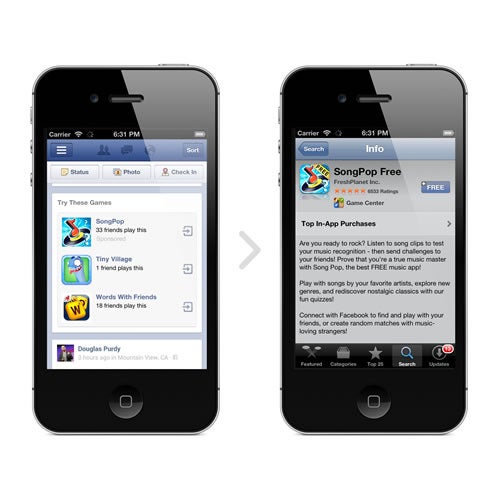 Sponsored Stories in the mobile news feed: Since early spring 2012, marketers are able to buy sponsored stories on mobile, either on a standalone basis or as part of a bundle that also included desktop news feed and right-hand placements.
Mobile App Install Ads: This ad type (shown at right) is available to app developers who are looking to drive installs, a bright spot in the paid mobile media landscape. Any developer can sign up to run the ads.
Mobile ad network (beta): Facebook is testing a mobile ad network, leveraging its interest data (but not action data such as “likes”) to identify and reach users while they’re using other apps. It’s sourcing inventory on a small handful of mobile ad exchanges and is a good way for Facebook users to discover new mobile apps and sites.
Logout Ads
Displayed when users log out of Facebook, it is the company’s only ad format that is strictly sold on a direct basis.







