

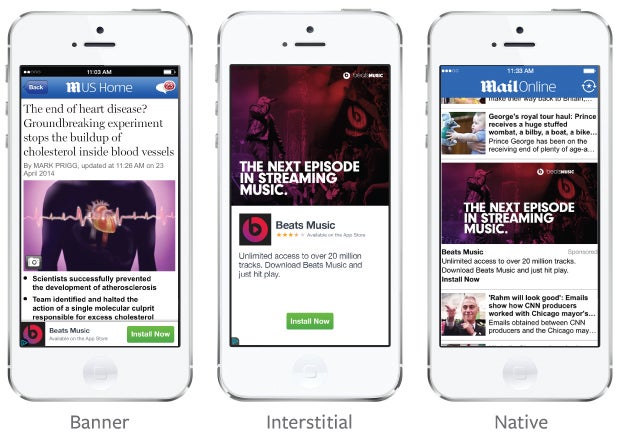
 Facebook unveiled its mobile ad network at its f8 Developer Conference on Wednesday, noting the Facebook Audience Network will include native advertising formats for developers that “want to invest a little more time.”
The ad network buy will be available to all advertisers via a “single click” within the Facebook Advertising interface as well as through its Advertising APIs. Targeting methods include Custom Audiences (first-party data), Core Audiences (standard targeting based on interests, behaviors, location and demographics) and Lookalike audiences. Available ad types also include traditional mobile banners and interstitials, said Deborah Liu, director of product management for platform monetization.
In its current form, FAN is limited to mobile app install ads, but Facebook intends to support a variety of marketing objectives including in-store and online sales.
Facebook has helped Target, Coca-Cola and the app Audible find more audiences to target using its data, Liu said. Target, for example, wanted to find audiences that already use its app and were fans of the movie “Frozen.” Facebook’s algorithms showed that Huffington Post readers were a match.
To retarget app users, mobile products manager Sriram Krishnan explained that Facebook Login is not the key connector between apps. Mobile users, in other words, do not need to log in to apps using Facebook in order for the company to deliver targeted ads through FAN. “We are comparing device IDs and data points with other app developers to find common users, which will let us know which apps are on your device,” he told AdExchanger. (Read more about the “Anonymous Login and an Updated Facebook Login.”)
Facebook’s access to personalized user data from its billion-plus users could potentially give advertisers a rich targeting experience that gives it an edge over other ad networks like Millennial Media and Google’s AdMob. In addition, Facebook will most likely receive even more insight into user preferences through some of its new products, such as its mobile “like” button.

The success of FAN depends on Facebook’s next steps, noted Andrew Foxwell, CEO of social ad firm Foxwell Digital. Two important factors are “the other online mobile partners Facebook will choose to utilize and engage with, and the degree to which Facebook can successfully replicate their unique advertising experience outside of their own platform,” Foxwell said. “Both (advertisers and publishers) need to feel comfortable in knowing not only how FAN will actually function but also how it will improve and enrich their online experiences.”
Additionally, Facebook unveiled new privacy controls for users accessing mobile apps built on its Parse developer platform, and has created an anonymous login to let users to trial app experiences without revealing their identity or passing along their email address.
Move Fast With ‘Stable Intra’
Facebook CEO Mark Zuckerberg kicked off the conference by describing the company’s focus on building a “stable mobile platform” and its move away from the mantra “move fast and break things” toward “move fast with stable infra.”
Zuckerberg also emphasized the idea of putting people first in its products and building trust among users. “We know some people are scared of that blue (log in with Facebook) button,” Zuckerberg said. “And if you’re not using an app you trust, you’re not going to give it a lot of permissions into your data.”
As part of that push towards building customer trust, Facebook will now allow users to approve line by line the data that they share with apps, such as their birthday, email address and phone number. The company is also adding an anonymous login capability to apps.
Update: Krishnan and Facebook engineer Vijaye Raji provided a few more details about FAN at a breakout session. Publishers will be able to set blacklists to block ads from specific apps as well as categories, such as all ads from sports apps, for example.
Publishers will also receive real-time performance stats, such as the number of ad requests, total number of impressions, click-through rates and revenue earned for each ad placement.
The Audience Network SDK also includes mediation adopters to integrate it into other ad networks. Krishnan and Raji remained mum on other details, however, such as the new ad network’s standard revenue share and the number of publishers that have already signed up for the network.







